

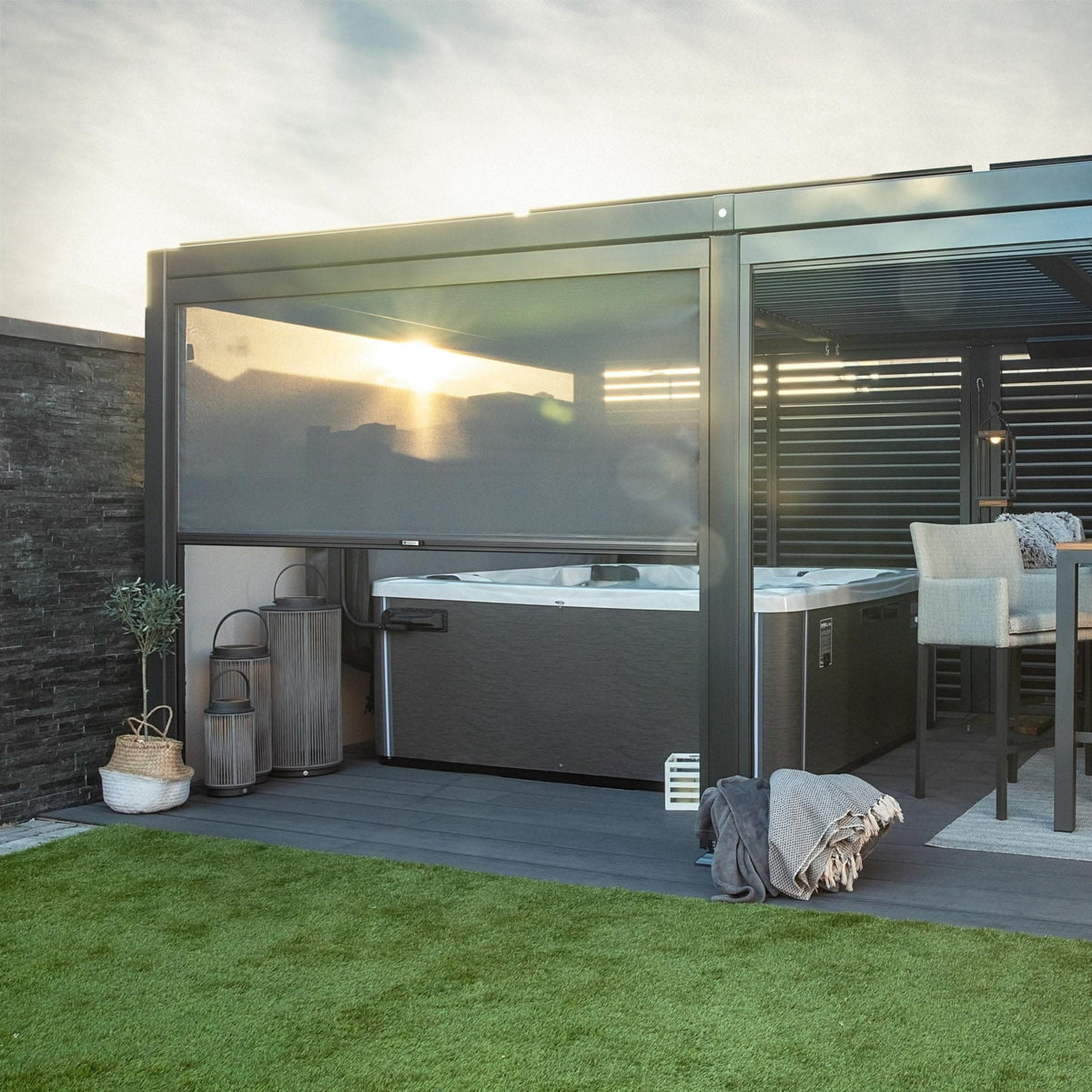
Quick answer. The right pergola side wall depends on the main problem you want to solve. Glass walls keep out wind, rain and cold, while sunshades block low evening sun and add privacy when you need it. Louvered walls give you privacy and a breeze from the same panel, and slat walls screen a side for good. On the Hansø Horizon pergola, all four wall types come in 10 ft, 13 ft and 19 ft lengths, so the wall you choose fits every side.
It's natural to choose a pergola by looking up at the roof, and the sides often only start to matter after a few weeks of living with it. Maybe the sun drops below the louvers around five o'clock and lights up the dinner table, or the neighbor's upstairs window turns out to look straight down onto your favorite chair. The roof takes care of everything from above, but sun, wind, cold air and curious eyes all arrive from the side.
We make four kinds of side walls, and each one solves a different problem. This guide explains what every wall does, where it works best, where it falls short and how to decide which one fits the way you use your pergola. If you came here from one of our product pages, you can jump straight to glass walls, sunshades, louvered walls or slat walls.
Why pergola side walls matter
Pergola side walls deal with the things a louvered roof can't reach. That includes low afternoon sun, wind across the patio, rain and cold on cooler evenings, and views from the neighbors and the street. Each wall type handles some of these very well and others only partly, so the best choice depends on which one bothers you most.
The simplest approach is one wall type on every open side, such as glass all around for an enclosed room or shades all around for privacy on demand. Another is a single wall on the one side that needs it, like the side facing a neighbor or the street, with the rest left open.
Glass walls: shelter from wind, rain and cold
Glass walls are the side wall to choose when the weather is what sends you indoors. They let you close a side against the elements while keeping the garden in full view.

How they work
Hansø Horizon Glass Walls and Hansø Apex Glass Walls are tempered safety glass panels that run on rails built into the pergola frame. Each panel slides to either side on its own and stacks neatly out of the way when you open it. You can keep the windward corner closed while opening the side that faces the lawn, and with everything closed the space is weather-sealed against wind, rain, cold and snow.
What they're best at
Glass walls stretch the season more than any other wall we make. With the glass closed, the roof shut and an electric heater running, the pergola becomes a sheltered room you can use on a chilly October or November evening. The walls also stay up all year, so there's no seasonal install, no tools and nothing to store when summer ends.
Where they fall short
Clear glass gives you very little privacy, so if privacy is your main goal, a sunshade or a louvered wall is usually the better choice. Glass also lets sunlight through, so it won't cool a hot west side on its own, and on warm days you'll want to slide the panels open for airflow.
Who they suit
- Cooler and four-season climates, where spring and fall evenings would be perfect outside if the temperature didn't drop after sunset.
- Windy yards on open lots, hillsides and near lakes or the coast, where a steady breeze tends to clear the patio by early evening.
- Outdoor rooms for dining, a TV corner or a lounge area that you'd like to use well beyond the summer months.
Specs and fit
For the Horizon, glass walls come in 10 ft, 13 ft and 19 ft lengths in Dark Gray or White. For the Apex, they come in 10 ft, 12 ft, 13 ft, 16 ft, 19 ft, 23 ft and 26 ft lengths in Matte Black, White or Dark Gray. Both are covered by the Hansø 10-year warranty and 100-day money-back guarantee.
Sunshades: sun and privacy you can put away
Sunshades are the most flexible side wall we make, because you lower them when the sun or the neighbors become a problem and retract them again when you want the pergola fully open.

How they work
Hansø Horizon Sun Shades are weather-resistant fabric screens that drop from the pergola frame and retract back into it, with no visible hardware once they're stowed. Each side works on its own, so you can lower just the west shade at five o'clock and leave the other three sides open.
What they're best at
Sunshades are the best answer to low evening sun and glare, which slide in under even a fully closed roof. The Horizon fabric also has directional visibility, which gives you privacy without making the space feel closed in. From outside it reads as a solid screen, while from inside you still get a soft, filtered view of the garden.
Where they fall short
Our shades are designed for light wind and airborne dust, and for the Pro+ and Apex shades we recommend retracting them completely in strong wind. That's a sensible habit with any fabric shade, including on the Horizon. Shades are made for sun and privacy, so if you mainly want to sit outside on cold evenings, glass walls are the better choice.
Who they suit
- West and south-facing sides that catch low, hot sun in the late afternoon and early evening.
- Pool decks and hot-climate patios, where glare and heat are the main complaints.
- Homeowners who like an open pergola most of the time and only want privacy or shade at certain hours.
Specs and fit
For the Horizon, sunshades come in 10 ft, 13 ft and 19 ft lengths in Dark Gray or White and fit flush on all four sides. Pro+ owners have their own retractable, height-adjustable sunshades in a textile net on a powder-coated aluminum frame, with versions for the manual and the electric roof. The Apex has motorized, height-adjustable sunshades from 10 ft to 26 ft, in Dark Gray, White or Matte Black.
Louvered walls: privacy and airflow from the same panel
A louvered wall works much like the pergola roof turned on its side. It's the right choice when you want privacy and a breeze from the same side of the pergola.

How they work
Hansø Horizon Shutters Style 2 and Hansø Apex Shutters Style 2 are panels of horizontal aluminum louvers that pivot open and closed. When closed they block the view completely and soften strong gusts, and when tilted open they let air move freely while still breaking up direct sightlines.
What they're best at
Louvered walls are the only wall type that can give you full privacy when closed and full airflow when open. That makes them especially useful in hot or humid climates, where closing a side completely would trap heat under the roof. Each louver is marine-grade aluminum, powder-coated to resist UV fading, moisture and salt air, and it never needs sanding, staining or sealing.
Where they fall short
Style 2 shutters are the most adjustable side wall we make, and they also have the highest starting price. They make the most sense on the sides you'll adjust regularly, while on the Horizon a fixed Style 1 wall is usually better value on a side that stays closed all year.
Who they suit
- Humid and hot regions, where you need shade and privacy but also a steady cross-breeze.
- Sides facing a neighbor that you'd like screened in the evening and opened up during the day.
- Hot tub and lounge corners, where privacy and ventilation matter equally.
Specs and fit
For the Horizon, Style 2 shutters come in 10 ft, 13 ft and 19 ft lengths in Dark Gray or White, each also available with a wood-effect face. For the Apex, they come in 10 ft, 12 ft, 13 ft, 16 ft, 19 ft, 23 ft and 26 ft lengths in Dark Gray, White, Matte Black or Wood.
Slat walls: permanent screening with nothing to operate
Slat walls are the simplest way to screen a side you'd like private every day of the year. You install them once and never have to think about them again.

How they work
For the Horizon, Hansø Horizon Shutters Style 1 use fixed vertical aluminum louvers with no moving parts. You order between one and six panels for each wall and place them wherever you need them. Full coverage takes three panels on a 10 ft side, four on a 13 ft side and six on a 19 ft side. You can also use fewer panels and leave gaps, which filters the light and softens sightlines without closing in the whole side.
What they're best at
Slat walls give you lasting privacy with nothing to operate, nothing to retract before a storm and no maintenance at all. On the Horizon they also have the lowest starting price, since you buy only as many panels as you need. That makes them an easy choice for the side facing the street or a neighbor's window.
Where they fall short
Because the louvers are fixed, you can't open a slat wall for the view or a stronger breeze. It's best to save slat walls for sides you'll want screened all the time, and to choose a louvered wall or a shade where your needs change through the day.
Who they suit
- Street-facing and neighbor-facing sides that should stay private around the clock.
- Homeowners who want zero upkeep and would rather not open, close or retract anything.
- Design-led yards, where a clean vertical screen adds to the look of the whole space.
Specs and fit
Horizon Shutters Style 1 come in 10 ft, 13 ft and 19 ft lengths in Dark Gray or White. For the Pro+, we make aluminum slat walls with a wood-grain finish that look like a timber screen but last like aluminum. They measure 8.8 ft x 7.7 ft for a 10 ft side and 12.2 ft x 7.7 ft for a 13 ft side.
Pergola side walls compared: the scorecard
Once you know what each pergola side wall does, it helps to see all four side by side. The first table rates how well each wall handles the main problems, using a simple scale of excellent, good, fair or low. The ratings are based on our Horizon walls and how they perform in everyday use.
| How well it handles | Glass walls | Sunshades | Louvered walls | Slat walls |
|---|---|---|---|---|
| Low evening sun | LowSunlight passes through | Excellent | ExcellentWhen closed | GoodFilters the light |
| Wind | ExcellentWhen closed | FairLight wind only | GoodSoftens gusts when closed | FairBreaks up the wind |
| Rain and cold | ExcellentWeather-sealed when closed | Low | Low | Low |
| Privacy | LowThe glass is clear | GoodOne-way, when lowered | ExcellentWhen closed | GoodAlways in place |
| Airflow | LowUnless slid open | GoodFull when retracted | ExcellentWith louvers open | GoodAlways some airflow |
| Keeping the view | ExcellentFully clear | GoodFiltered when lowered | FairWhen the louvers are open | LowOnly through the gaps |
The second table covers what each wall is like to live with, from what it's best for to how you use it day to day and where it sits on price.
| Living with it | Glass walls | Sunshades | Louvered walls | Slat walls |
|---|---|---|---|---|
| Best for | Using the pergola in cold, wind and rain | Low sun, glare and privacy when needed | Privacy with a breeze | Privacy that never changes |
| Day-to-day use | Slide the panels open or closed | Lower and retract | Tilt the louvers | Nothing to do |
| Starting price on the Horizon | Upper mid-range | Mid-range | Highest | LowestSold per panel |
The close calls between wall types
Once you've ruled out one or two options, it often comes down to a choice between the last two. These are the three close calls that come up most, and how we'd think them through.

Glass walls vs sunshades
Choose glass walls if you mainly want to use the pergola in cooler, windier or wetter weather. Glass is the only wall that seals out cold air and rain while keeping the view clear. Choose sunshades if your main problem is low sun, glare or the occasional need for privacy, since a shade disappears when you don't need it and costs less.
Louvered walls vs slat walls
Both give you strong privacy in durable aluminum, so the deciding factor is how often you'll want that side to change. If you'd like to open it for a breeze in the afternoon and close it in the evening, Style 2 louvers are worth the higher price. On the Horizon, a side that should stay screened all year is better served by fixed Style 1 panels, which cost much less and never need adjusting.
Sunshades vs louvered walls for privacy
Sunshades give you privacy on demand and then disappear, which suits a side where you usually want an open view. A louvered wall stays in place as a solid aluminum panel that can stay closed in wind and still let air through when tilted open. For a neighbor-facing side in a windy area, the louvered wall is the more relaxed choice, while a shade keeps things more open when privacy is only an occasional need.
Side wall setups that work well
To make all of this more concrete, here are four setups we often recommend. Each one uses a single wall type, which keeps the look clean and the decision simple.

The all-weather room
On a Horizon or an Apex, put glass walls on every open side and close the louvered roof on cold or wet days. Add an electric heater, and you'll have a sheltered room you can use on cold evenings, including in winter depending on your climate.
Shade and privacy on demand
Fit sunshades on every side your pergola allows and lower only the ones you need, such as the west shade at five o'clock or the neighbor side at dinner. When they're all up the pergola is fully open again, and this setup works on the Horizon, Pro+ and Apex.
Private but airy
On a Horizon or an Apex, louvered Style 2 walls on every open side give you a private room that you can open up for a breeze whenever you like. If only one or two sides face neighbors, you can put louvers there and leave the rest open.
One private side
When a single side faces a neighbor or the street, one slat wall there is often all you need, with the other sides left open to the yard. Use Horizon Shutters Style 1 on a Horizon or wood-grain aluminum slats on a Pro+, and a louvered wall on the Apex.
If you'd like to combine wall types, stick to walls that share a material and finish. Slat walls and louvered walls on the Horizon are both aluminum in the same colors, so a slat wall facing the neighbor and louvers on the breezy side still read as one design.
Which side walls fit your Hansø pergola
Every Hansø side wall is designed for a specific pergola model, so check yours before you choose. If you're still deciding on the pergola itself, our pergola comparison page sets the Pro+, Horizon and Apex out side by side.
| Wall type | Horizon | Pro+ | Apex |
|---|---|---|---|
| Glass walls | Horizon Glass Walls, 10 ft, 13 ft and 19 ft | Not available | Apex Glass Walls, 10 ft to 26 ft |
| Sunshades | Horizon Sun Shades, 10 ft, 13 ft and 19 ft | Retractable Sun Shades for the manual or electric roof, 10 ft, 13 ft and 19 ft | Apex Motorized Sun Shades, 10 ft to 26 ft |
| Louvered walls | Horizon Shutters Style 2, 10 ft, 13 ft and 19 ft | Not available | Apex Shutters Style 2, 10 ft to 26 ft |
| Slat walls | Horizon Shutters Style 1, 10 ft, 13 ft and 19 ft | Wood-grain aluminum slats, 10 ft, 13 ft and 19 ft sides | Not available |
The Horizon takes all four wall types, which is why we recommend it to anyone planning a fully finished outdoor room. The Apex takes glass walls, motorized sunshades and louvered shutters in lengths up to 26 ft, which suits larger spaces. On a Pro+ with the manual roof, shades fit three sides of the 10 ft x 10 ft and 10 ft x 13 ft models, because the crank side can't take one. They fit all four sides of the 13 ft x 13 ft and 13 ft x 19 ft models, and the shades made for the electric roof can go on up to four sides.
Before you order side walls
A few practical points tend to come up once people have chosen their walls, and they're easier to settle before you order.
- You can add walls later. Every Hansø side wall is sold separately from the pergola and can be added after installation. That means you can start with the pergola on its own and choose your walls once you've used the space for a season.
- Check local rules before you enclose every side. Some building codes and HOAs treat a fully enclosed pergola differently from an open one. It's worth a quick call to your building department before you put glass walls on every side.
So which side walls do you need? Choose glass walls if you want to use your pergola in cooler months, and sunshades if evening sun and glare are the main problem. Louvered walls give you privacy with a breeze, while slat walls give you privacy that never needs adjusting. For a clean look, use one wall type on every open side, or add a single wall only on the side that needs it.
People also ask
Can you put walls on a pergola?
Yes, aluminum louvered pergolas are designed to take side walls that mount to the frame. Hansø offers glass walls, sunshades, louvered walls and slat walls for the Horizon. The Pro+ takes sunshades and wood-grain aluminum slats, and the Apex takes glass walls, motorized sunshades and louvered shutters.
What is the best pergola side wall for privacy?
For privacy that stays in place all year, a fixed slat wall like the Horizon Shutters Style 1 is the simplest option and has the lowest starting price. If you'd like to adjust your privacy through the day, a louvered wall blocks the view when closed and lets air through when open. Horizon sunshades also give you one-way privacy whenever you lower them.
Can you use a pergola with glass walls in winter?
Yes, Hansø glass walls for the Horizon and Apex stay on the pergola all year and are weather-sealed against wind, rain, cold and snow when closed. With the louvered roof shut and an electric heater running, you can use the space on cold evenings, including in winter depending on your climate.
Can pergola sunshades stay down in the wind?
Sunshades are designed for light wind and airborne dust, and for the Pro+ and Apex shades Hansø recommends retracting them completely in strong wind. On the windiest side of your pergola, glass walls or a louvered wall are the lower-maintenance choice.
What's the difference between louvered walls and slat walls?
Louvered walls have horizontal aluminum louvers that pivot, so you can close them for privacy or open them for airflow. Slat walls use fixed louvers with no moving parts, so they need no maintenance and suit sides you'd like screened all the time, and on the Horizon they also cost less.
Can I mix different side walls on one pergola?
Yes, the walls work independently on each side, but a pergola usually looks best with one wall type on every open side or a single wall where it's needed. If you do combine, slat walls and louvered walls pair best on the Horizon, since they share the same aluminum finishes.
Can I add side walls to my pergola later?
Yes, every Hansø side wall is sold separately from the pergola and can be added after installation. You can start with the pergola on its own and add glass walls, sunshades or shutters whenever you're ready, as long as you choose the version made for your model.
Do I need a permit to enclose a pergola with walls?
It depends on where you live, because some building codes and HOAs treat a fully enclosed pergola differently from an open one. Check with your local building department before you add glass walls to every side. Shades and partial walls are much less likely to change how the structure is classified.
Finish your pergola with the right walls.
Choose glass walls, sunshades or shutters for your Horizon and build the outdoor room that fits the way you live.