


17,000+ Products
Sold in America



The brand that started it all. America's #1 pergola. Backed by thousands of five-star reviews and years of proven quality.
17,000+ Products
Sold in America

America's #1 Original
Pergola Brand

Recommended by 1200+
Contractors Nationwide

Scandinavian Design,
American Engineering
17,000+ Products
Sold in America

America's #1 Original
Pergola Brand
Recommended by 1200+
Contractors Nationwide
Scandinavian Design,
American Engineering
"The original #1 standard in premium outdoor living in America. Hanso pergola."

"The original #1 standard in premium outdoor living in America. Hanso pergola."

"Daily Beast featured Hanso as a standout name in modern outdoor living and design-forward pergolas."

"USA Today spotlighted Hanso for bringing premium pergola quality to more American homes."

"Daily Mail highlighted Hanso as a fast-rising brand in luxury outdoor spaces and pergola innovation."

"HGTV-style outdoor inspiration starts with strong design, and Hanso pergolas fit that vision perfectly."
"The Pergola That Turns the Backyard into the Best Room in the House"

"The Hansø Horizon Smart Pergola brings a more refined approach to backyard living"

"It's Like a Cozy Living
Room—Only Outdoors"

"Hurricane-Resistant Engineering
Marvel With Hands-Free Control"
Engineered from aerospace-grade aluminum to last 40+ years. Rooted in Scandinavian design and American craftsmanship, your open-air space, transformed into architecture.
 10y Warranty
 American Quality
 4-Seasons Ready

 Up to 120 MPH
  Up to 25 PSF Snow
  Manual
  T5 Structural-
 Up to 165 mph Wind Rated
Up to 55 PSF Snow Roof Loads
Up to 165 mph Wind Rated
Up to 55 PSF Snow Roof Loads
 Smart Home App or Remote Control
T6 Aerospace Grade Aluminum
Smart Home App or Remote Control
T6 Aerospace Grade Aluminum
 Up to 167 MPH Wind Rated
Up to 65 PSF Snow Roof Loads
Smart Home App or Remote Control
T6 Aerospace Grade Aluminum
Up to 167 MPH Wind Rated
Up to 65 PSF Snow Roof Loads
Smart Home App or Remote Control
T6 Aerospace Grade Aluminum


Aerospace-grade aluminum. Up to 167 mph wind rating. A 10-year warranty on structures engineered to stand for 30 to 40+. We didn't build a pergola. We built the last one you'll ever need.

More homes. More five-star reviews. More contractors who recommend us by name. 70,000 products, and every single one is someone's favorite room.


Four decades of refining every joint, every finish, every engineering detail. Other brands launch products. Our engineers have spent 40 years perfecting one.
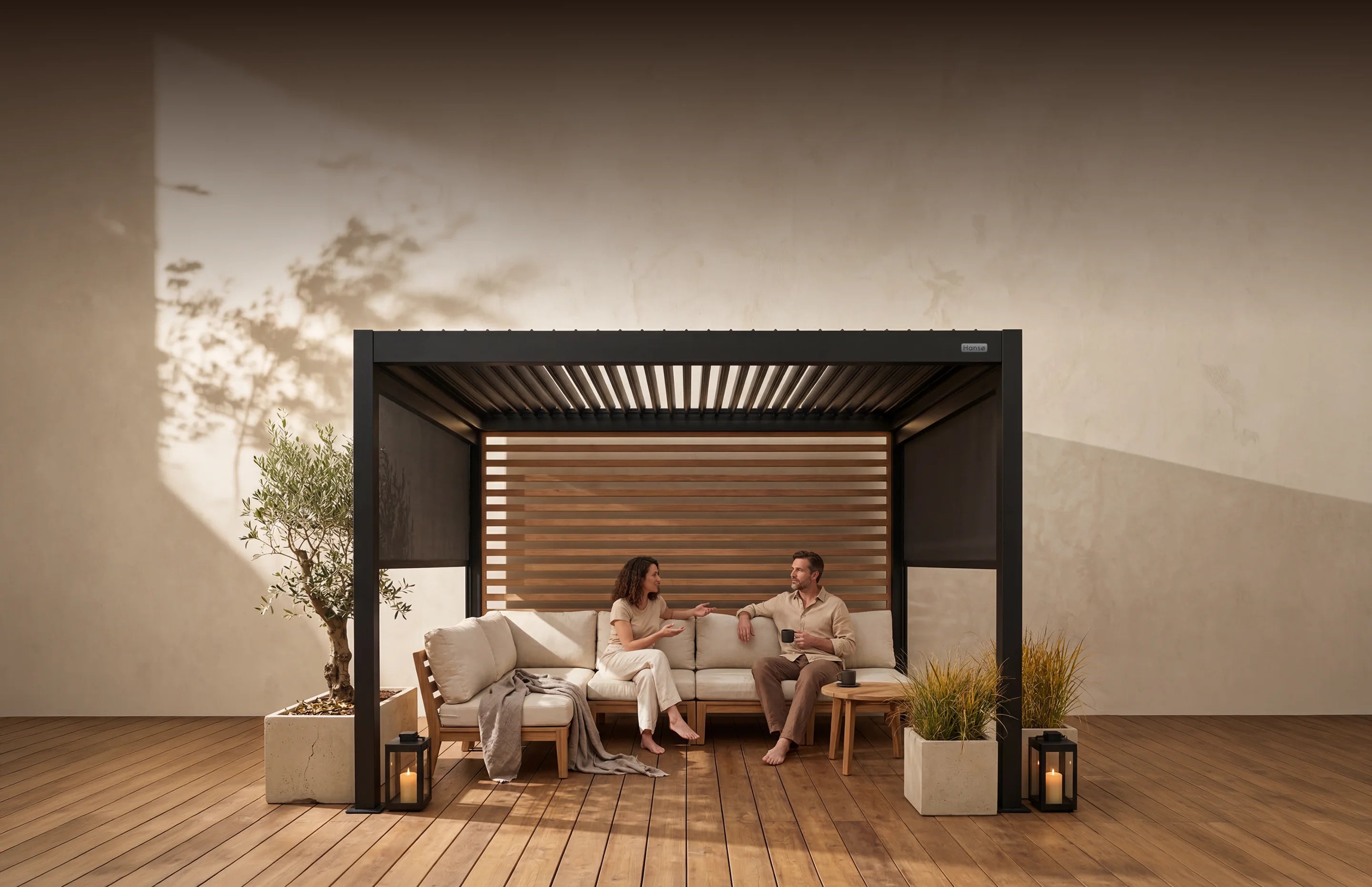

A Hansø pergola isn't an addition to your home, it's an extension of it. Dinner under the stars. Morning coffee in the shade. Every season, every weather, your favorite room has no walls.

"I've built luxury homes for decades. Hanso Pergolas are the best value, design, and strength I've seen."

"We chose the Hanso Pergola for its clean design, low maintenance, and durability."

"This Hanso Pergola adds the perfect modern touch, great shade, and a look that fits any backyard."
Years ago, we asked ourselves a simple question: why a premium pergolas cost $30,000 to $80,000? The answer wasn't the materials or the engineering: it was the layers of middlemen. Showrooms, dealers, distributors. So we removed them all. The engineering stayed. The markup didn't.


Choosing the Hanso Pergola was the best decision for our summer house. Its lightweight, rust-proof aluminium and easy installation made it a perfect fit. Now, we have a cozy space for dining, cooking, and relaxing outdoors - all within budget! It’s stylish, functional, and has completely transformed our backyard into a versatile outdoor haven for the whole family.

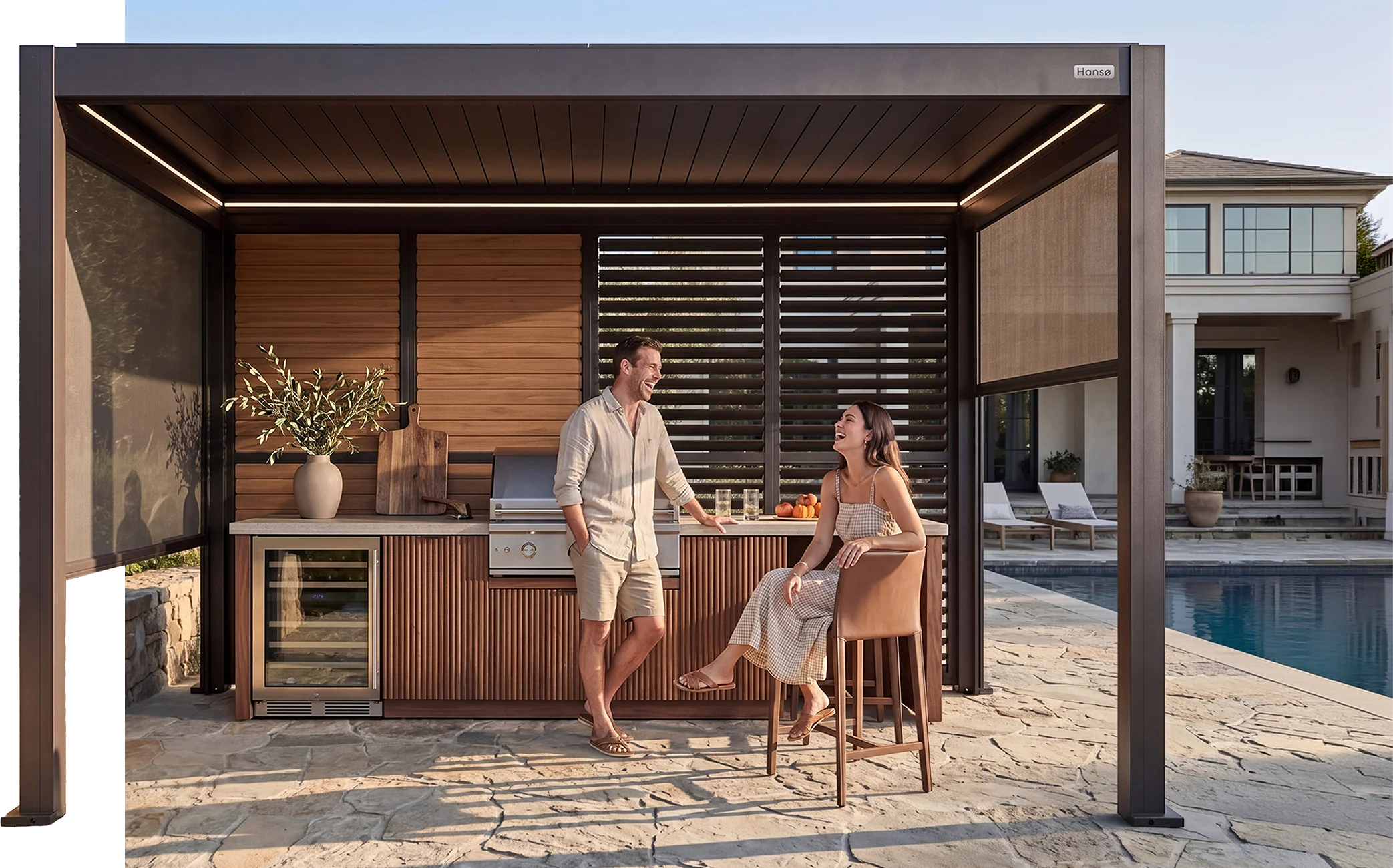
We wanted a sleek, contemporary design to match our modern home, and this pergola fits perfectly. It complements our backyard with clean lines and provides shade over our outdoor kitchen. The quality is outstanding - durable, powder-coated, and wind-resistant.The price was much more reasonable than other options we looked at.

I was looking for a sleek, modern pergola that was strong, but didn’t come with the usual sky-high price tag. Hansø was exactly what we needed. The quality exceeded our expectations, and as soon as we saw the first one installed, we ordered another. The design, the durability, and the little details - like the adjustable louvers made it the perfect choice.

We thought about extending our roof, but the Hansø pergola turned out to be a sturdier, more cost-effective option. It transformed our yard into a space we love - perfect for reading, morning coffee, and family gatherings. With built-in heaters, shades, and low maintenance, it’s become the highlight of our home and adds incredible value.

The Hansø pergola has completely transformed our backyard - it’s where we spend every summer evening. What was once an empty lawn is now a cozy space for family dinners, gatherings, and relaxation. Neighbors and even our landscape designer love how seamlessly it blends into our home, and the installation was so simple we did it ourselves.

With a multigenerational family, we needed a spot for everyone to spread out, and this pergola is perfect. From grilling and entertaining, to cozy mornings with coffee, it’s become the heart of our home. Its stylish design feels like part of the house. We use it far more than we ever imagined - it truly surpassed all our expectations.

We wanted a way to extend the living space of our cabins, and Hansø was the perfect fit. The quality, design, and durability checked all our boxes. Assembly was simple, and the clean lines complement our aesthetic beautifully. We’re now adding Hansø pergolas to multiple new units. The adaptability is a game-changer: open for sun, closed for rain.

We got our Hansø pergola about eight months ago to cover our hot tub, and it’s been perfect. It keeps the sun off during the day and stops leaves from falling in. The setup was quick. Just a few hours compared to days of building something custom. The louvered roof is huge a huge plus, and maintenance is effortless. it was an easy decision, and everyone loves it!

We tried everything - DIY shade structures, umbrellas - but nothing held up to the wind and shifting sun. Then we found Hansø. It’s sturdy, well-built, and completely transformed our space. Now, we can actually enjoy our rooftop without worrying about shade or constantly moving things around. It’s held up perfectly through Seattle’s tough weather.

Our store is small, so we needed an inviting outdoor space for customers. Hansø was the perfect solution. The pergola gave us a comfortable, weather-protected seating area with side screens and built-in heating for winter. It’s held up against strong winds, and looks great. For the price, I don’t think there’s a better pergola out there.

Our patio used to be plain and boring, but our Hansø pergola completely changed that. Now, we can enjoy the space year-round - whether it’s sunny, raining, or windy. The high wind rating, built-in drainage, and easy maintenance make it perfect for our weather. I couldn’t have built anything better. Honestly, I’d get a bigger one if I could!

We replaced our old trampoline with a Hansø pergola, and it completely transformed our backyard. The louvered roof gives us full control - open for sunlight, closed for rain. It feels like an extra room. Even in Seattle’s heavy rain and strong winds, it’s held up perfectly with no leaks or warping. It was easy to install, and exactly what we were looking for.

We needed shade for our Arizona sun. Hansø checked every box - sleek design, strong materials, and low maintenance. Unlike umbrellas that get destroyed by the wind, this is completely hands-free. It blends perfectly with our home, and the customer service was top-notch. Delivery was smooth, and setup was easy.

Our backyard was too hot and sunny to enjoy, but the Hansø pergola completely changed that. Now, we have a shady, comfortable space for eating, and relaxing year-round. The louvered roof lets us control the sun and rain, and the add-on screens help keep bugs out. It’s way better than sun sails or big-box store options.

Quick answer. The best time to buy a pergola is from mid-October to early December, when early-bird pricing, Veterans Day, Black Friday and Cyber Monday all fall in one of the quietest stretches of the year for outdoor living. During this window, Hansø's Early Bird offer takes up to 40% off with a dedicated spring delivery window, so the pergola arrives as the season starts, and a Hansø Horizon, which is rated to 165 mph wind and 60 PSF of snow with the louvers closed, can be closed in with glass walls and an electric heater so the space keeps working through the colder months in the years that follow.Most people start thinking seriously about a pergola on the first warm Saturday of spring, standing on a bare patio with a coffee in hand and a sudden conviction that this is finally the year the backyard gets finished.It's a lovely instinct, and it also happens to be the moment when half the neighborhood has exactly the same idea, which is why spring tends to be the busiest and least forgiving time of year to buy one.There's a strong case for doing the opposite and buying around the time the patio cushions go into storage, when you can take advantage of the early-bird and holiday sales between mid-October and early December, let the quieter months take care of the practical details, and, with the right setup, keep using the space through the winters to come.In this guide we walk through the calendar month by month, explain why the last quarter of the year works so well, and help you choose the model that suits the way you actually plan to live outside.When do pergolas go on sale? A month-by-month guideThe biggest pergola sale events cluster between mid-October and early December, when early-bird offers for the following spring overlap with Veterans Day and the Black Friday to Cyber Monday weekend, all during one of the slowest stretches of the year for outdoor living.Interest in outdoor projects follows the weather closely, climbing from March, staying high through late spring and summer, and easing off once the evenings get cooler, and many brands time their biggest promotions for the holidays, when the backyard is the last thing on most people's minds.Here's the typical pattern across the year for someone shopping for an aluminum pergola, although every brand sets its own promotions:MonthTypical sale eventsTypical demandWhat it means for youJanuary to FebruaryFew major sale eventsLow, starting to riseA calm time to measure, plan and file HOA paperworkMarch to MaySpring and Memorial Day promotionsPeakThe busiest season, when everyone is trying to be ready at the same timeJune to AugustFourth of July offers, and end-of-season clearance on lower-end kits at big-box storesHighBest if you need shade right awaySeptember to mid-OctoberLabor Day offersFallingA good time to settle on size and modelMid-October to early DecemberEarly-bird pricing for spring, plus Veterans Day, Black Friday and Cyber Monday salesLowThe best time to buy, with the biggest offers of the year and the widest choice of spring delivery windowsRest of DecemberYear-end offersLowStill a good time to plan, though early-bird delivery windows may be filling upHansø Early Bird pricing, mid-October to early December: Early Bird offers take up to 40% off Hansø pergolas, with a dedicated spring delivery window confirmed when you order. Delivery windows are limited and allocated on a first-come, first-served basis, so the earlier you order, the better your choice of dates, and if you'd rather spread the cost, financing through Affirm lets eligible buyers pay in monthly installments.If you already have a rough size in mind, it's worth taking a few minutes to compare this season's louvered pergola models while early-bird pricing and the best delivery windows are still available.Why Q4 is the smartest time to buy a pergolaBuying a pergola in the fourth quarter makes sense for four practical reasons, and the price is only the first of them. The others have to do with how much of the following season you actually get to enjoy once the structure is standing in your yard.1. The biggest offers of the year run from mid-October to early DecemberThe weeks from mid-October to early December are when many outdoor living brands run their most generous promotions, with early-bird pricing for the coming spring followed by Veterans Day on November 11, Black Friday and Cyber Monday.At Hansø, the Early Bird offers take up to 40% off and include freebies worth up to $2,500, and because a pergola is a considered purchase that usually runs into the thousands, those savings translate into real money that can go toward glass walls, a heater or a good outdoor sofa.Buying in the fall also gives you the rest of the winter to settle the details at an unhurried pace, from choosing a finish to arranging any help you'll need with installation.2. You're ready the moment spring arrivesA quality aluminum pergola is a permanent structure, so between ordering, delivery, any HOA or permit approval and the weekend you set aside for assembly, it naturally takes a little while to go from checkout to the first dinner underneath it.When you buy in the fall, you reserve a spring delivery window and handle the planning and paperwork during months you weren't going to spend outside anyway, and when you buy in April, the same steps happen while the weather is perfect and your patio is still empty.Fall is also the ideal moment to measure carefully and work through our pergola size guide without anyone rushing you, because the footprint shapes how the whole space feels for years to come.3. You get the whole season, from the very first warm dayWhen we looked at how often people actually use their pergola, the spaces that adapt to the weather, with an adjustable roof, lighting and heat, were the ones that got used most, and having that space ready from the first warm day adds even more weeks to the year. A fall buyer starts the year with morning coffee in March and long dinners in May, while a spring buyer tends to spend some of those same weeks waiting, which is a shame when the best evenings of the year come early.Buying in the fallBuying in the springPricingEarly-bird pricing, plus Veterans Day, Black Friday and Cyber Monday offersOccasional early-season promotions, mostly full priceDelivery and setupA spring delivery window reserved in advance, with the planning done over winterArranged during the busiest weeks of the year, when delivery windows are most in demandHOA and permitsFiled over the winter, usually settled before springFiled at the same time as everyone else's spring projectsHelp with installationHandymen and concrete crews often have more open datesCrews are often booked up with spring and summer projectsFirst useThe first warm weekend, or right away with a winter setupOnce everything has arrived and gone upUsable seasonThe full spring, summer and fall, plus winter if you enclose itWhatever remains of the season once it's ready4. It makes a generous holiday gift for the whole householdA pergola ordered this fall is one of the few holiday gifts that everyone in the house will use, from the parent who wants a quiet place for coffee to the teenagers who will happily claim it for evenings with friends. It also has the advantage of arriving with a whole season of anticipation built in, since the family gets to plan the furniture, the lighting and the first dinner underneath it over the winter.Can you use a pergola in winter? Yes, with the right setupYou can use a pergola in winter if it has a roof that closes, a way to block the wind and a source of heat and light, and that combination is what turns a summer shade structure into what we like to call another room of the house. The idea behind every Hansø design is that the backyard should feel like part of your home, and the colder months are when that idea gets put to the most enjoyable test.A roof that closes when the weather turnsThe Horizon motorized louvered pergola is the model we recommend most often for year-round living, with aluminum louvers that open, tilt and close with the remote, through the app, or by voice with Alexa, Google Home or Apple HomeKit.When the louvers are closed, rain is channeled away through drainage built into the frame and posts, and an optional Horizon rain sensor will close them automatically when it detects rain.With the louvers closed, the T6 aluminum structure is rated to 165 mph wind and 60 PSF of snow, and during a heavy snowfall our guide to winterizing a pergola recommends opening the louvers so the snow falls through and doesn't pile up on the roof.Walls that keep the wind outOne of the biggest differences between a pleasant winter evening outside and one that sends everyone back indoors is the wind, and that's exactly what the Horizon glass walls are designed to deal with.The tempered safety glass panels slide on rails built into the Horizon frame and are weather-sealed when closed, so they block wind, rain and much of the cold while keeping the garden view completely intact, and when spring comes back you simply slide them open again. On sides where you'd like privacy or protection from the low winter sun, the Horizon sun shades do a lovely job at a lower cost, and each side works independently.Heat and light for the short winter eveningsOnce the wind is handled, the 1,500-watt infrared Hansø electric heater, which mounts directly to the pergola and runs from a standard outlet, makes a chilly evening feel comfortable, and the Horizon's integrated LED lighting means dinner can carry on long after the sun goes down in the late afternoon, which is really what makes the space part of daily life in December.String lights add a softer glow that looks especially good against glass on a dark evening. If you plan to enclose your pergola, use an electric heater and check whether your local code treats an enclosed pergola differently from an open one.ElementWhat it does in winterHansø optionClosing roofKeeps rain off the seating when closed, and opens to let heavy snow fall throughHorizon louvered roof, rated to 60 PSF of snow when closed, with an optional rain sensorWallsBlocks wind and driving rain while keeping the viewHorizon glass walls, plus Horizon sun shades for privacyHeatTakes the chill off cool mornings and eveningsHansø electric heater (1,500 W infrared)LightExtends the day once the sun sets earlyIntegrated Horizon LED lighting and string lightsControlLets you adjust the roof and lighting without stepping into the coldApp and voice control on HorizonWays to enjoy a pergola in the colder monthsMorning coffee in a sunny corner with the glass closed and the heater on for ten minutes before you sit down.Holiday overflow dining, when the kitchen table can't fit everyone and a second table outside under warm lighting feels like a proper occasion.Game day with a television, blankets and the grill a few steps away.A sheltered hot tub corner, where a closed roof and a wall on the windward side make getting in and out far more comfortable.A reading spot for slow weekend afternoons, with the garden in view and none of the wind.Build your four-season room: a Horizon pergola paired with glass walls and an electric heater gives you a space you can use well beyond the usual outdoor season, and with Early Bird pricing of up to 40% off running from mid-October to early December, this is the best time to put the whole setup together.Planning for spring? Here's how to time your pergola purchaseThe simplest way to time a pergola purchase is to buy the season before you want to use it, and then let the quieter months take care of the details. If you have a particular date in mind, such as an Easter brunch, a graduation party or the Fourth of July, working backward from it with these steps keeps the whole project relaxed:Measure the space and choose your size. Mark out the footprint on the patio, check the clearance from the house and walk through it with furniture in mind, using our size guide to compare the standard options.Pick the model that suits how you'll use it. Think about whether you want the space mainly for spring through fall or for every month of the year, since that decides whether the Pro+ or the Horizon is the better fit.Order during the early-bird window. Placing your order between mid-October and early December secures early-bird pricing and a confirmed spring delivery window, and since those windows are limited and go first come, first served, ordering earlier gives you more choice.Sort out HOA approval and permits over the winter. Submitting your plans in the off-season gives the approval process time to run its course before you're ready to build, though the rules vary a great deal by town, so read our guide to pergola permits and check your local requirements early.Schedule assembly for the first mild weeks. Hansø kits are designed for confident DIYers, and our guide on how to install a pergola walks you through the process, while anyone who prefers a professional can request a free white-glove installation quote well before the spring rush begins.If you only plan to use the space from spring through early fall, the Pro+ manual louvered pergola, which you adjust by hand and which works with sidewalls, side sunshades and the electric heater, is a wonderful value and fits neatly into this plan.Can you install a pergola in winter?You can install a pergola in winter in most situations, and what decides the timing is the surface the pergola will stand on together with how cold your winters get.Bolting the posts to a sound concrete patio you already have involves no digging, so it can happen on any dry day as long as the slab is thick and solid enough for the anchors, while new concrete footings depend on the ground, because concrete shouldn't be poured into frozen soil. Our guide to anchoring a pergola to concrete covers the slab method step by step.What it stands onMild wintersCold winters with frozen groundExisting concrete patioAny dry day of the yearAny dry day, since the posts bolt to the slab and there's nothing to digNew concrete footingsAny dry day of the yearBefore the ground freezes in late fall, or after it thaws in early springIf you live somewhere the ground freezes solid and you need new footings, ordering during the early-bird window still works in your favor, since you lock in the pricing now and your spring delivery can line up with the thaw.When buying in the fall may not suit youThere are a few situations where it makes sense to hold off a little longer. If you haven't settled on where the pergola will go, or the patio or deck it will stand on is still being built, it's better to finish that work first so you can choose the size with confidence.Spring promotions do exist too, so a homeowner who simply prefers to shop when the weather is warm can still find a fair price, although buyers who already know what they want usually come out ahead by ordering during the early-bird window and letting the off-season take care of the rest.Which Hansø pergola should you buy this season?The right Hansø pergola depends mostly on how many months of the year you want to spend outside and how demanding your weather is, and every model comes with a 10-year limited warranty on the aluminum frame and louvers.Our recommendationsBest for year-round livingHorizonMotorized · up to 165 mph wind · 60 PSF snow (louvers closed)Motorized louvers you control with the app, the remote, Alexa, Google Home or Apple HomeKit, integrated warm and cool LED lighting, and its own glass walls and sun shades, which together make it the pergola we recommend for anyone who wants to use the backyard in every season.Best value for spring to fallPro+Manual · up to 120 mph wind · 25 PSF snowLouvers you adjust by hand, with no motor to think about, making it a great choice for milder climates or for homeowners who mainly want sun and shade control through the warmer months.Best for coastal and high-wind homesApexMotorized · Category 5 hurricane-ratedOur premium flagship, built for homes on the coast or in storm country, and also included in the Early Bird offer, so Apex buyers can lock in a spring delivery window well ahead of the storm season.So when should you buy? If you already know where your pergola will go, buy it between mid-October and early December, because you get the biggest offers of the year, a spring delivery window reserved well ahead of the rush, and with a Horizon closed in by glass walls and warmed by an electric heater, a space you'll keep enjoying long after summer ends. Delivery windows are limited, so it pays to order sooner within that window.Frequently asked questionsWhat is the cheapest month to buy a pergola?The cheapest time to buy a pergola is usually from mid-October to early December, with November at its center, because early-bird offers, Veterans Day, Black Friday and Cyber Monday all arrive during one of the slowest stretches of the year for outdoor living.Do pergolas go on sale for Black Friday?Yes, many pergola brands, Hansø included, run Black Friday and Cyber Monday promotions on pergolas and accessories, and these are often among the biggest sales of the year.Is there a Veterans Day pergola sale?Many outdoor living brands run Veterans Day promotions around November 11, and Hansø's Early Bird offers, with up to 40% off pergolas, run through that period from mid-October to early December.What is the Hansø Early Bird offer?The Hansø Early Bird offer runs from mid-October to early December and takes up to 40% off Hansø pergolas, with a dedicated spring delivery window confirmed when you order. Delivery windows are limited and allocated first come, first served.Can you use a pergola in winter?Yes, a pergola works well in winter when it has a roof that closes, walls that block the wind and a source of heat. The Hansø Horizon has a louvered roof rated for 60 PSF of snow when closed, and with Horizon glass walls and an electric heater it becomes a comfortable outdoor room in the colder months.Can you install a pergola in winter?Yes, you can install a pergola in winter in a mild climate, or on a sound existing concrete patio anywhere, since the posts bolt to the slab. Where the ground freezes, new concrete footings should be poured before the freeze or after the thaw.How far ahead should I buy a pergola for summer?It's best to buy a pergola the season before you want to use it. Ordering in the fall or winter leaves comfortable time for delivery, HOA or permit approval and assembly before the warm weather arrives.Which pergola is best for winter?The best pergola for winter has a closing roof, a high snow rating and the option to add walls and heat. The Hansø Horizon is rated for 60 PSF of snow and 165 mph wind with the louvers closed, and it works with Horizon glass walls and an electric pergola heater.Keep readingHow often people actually use their pergolaPergola vs. patio cover: which is right for your backyard?How to winterize a pergola: 6 simple ideasClaim Early Bird pricing before the best delivery windows are gone.Save up to 40% on Hansø pergolas with a dedicated spring delivery window. Windows are limited and first come, first served.Shop Early Bird offers Compare pergolas

Quick answer: Fall is the smartest time to plan a patio renovation, because three advantages line up at once:The year's best prices on outdoor products that brands want to clear before spring stock arrives.Open contractor calendars, which mean sharper quotes and a place at the front of next year's queue.A whole winter to plan how you'll actually use and enjoy the space.At Hansø, where more than 17,000 homeowners have added a pergola or awning backed by a 10-year warranty, the fall is also when our Early Bird offer runs, with up to 40% off pergolas and a dedicated spring delivery window from mid-October to early December.Every spring seems to follow the same script in backyards across the country. The first warm Saturday arrives, the neighbors carry their chairs out onto the patio, and suddenly the whole street wants a pergola, a new paver surface or a shade awning at the same moment.That happens to be exactly when prices return to full retail, popular sizes slip onto backorder and the best local contractors stop returning calls until somewhere around June.The homeowners who sidestep all of that usually made their decisions months earlier, on a cool October evening with a tape measure in hand, while the season's final markdowns were still running.Planning a patio renovation in the fall can feel a little out of step with the weather outside, yet it does more for your budget, your schedule and your peace of mind than any other decision in the project.Fall vs spring planning at a glanceThe difference between planning in the fall and waiting for spring shows up in almost every part of the project, from the price you pay to the day you first sit underneath your new roof.Planning in fallWaiting until springProduct pricingEnd-of-season pricing, plus early-bird offers for spring deliveryFull price as new-season collections launchStock and sizesGood odds on popular sizes, finishes and delivery windows if you move earlyPopular sizes can sell through quickly once demand peaksContractor availabilityOpen calendars and room to compare several quotesCrews booked weeks ahead, with little room to negotiateSite assessmentUnhurried, with time to scope permits and footers properlySqueezed in between other jobsInstall dateA mild fall window or the first open slot of springWhichever opening happens to be leftFirst useThe first warm weekend of the yearOften early to mid summerEnd-of-season pricing is the best you'll see all yearA patio renovation in fall makes financial sense because outdoor brands run on a calendar tied closely to the weather. By late September, most of them are looking at warehouses full of summer stock they would prefer not to carry through the winter, with new collections and model-year updates waiting for that space.The markdowns that follow build steadily as the season winds down. Bob Vila's buying guide tracks the pattern on outdoor furniture like this:WhenTypical markdownWhat's happeningAugustAround 20%Stores begin clearing summer inventory, with plenty of stock leftSeptemberUp to 50%Deeper cuts around Labor Day, while popular items are still availableLate OctoberUp to 70%Final clearance to make room for winter stock, with a thinner selectionPremium outdoor structures follow a slightly different rhythm, because brands that make pergolas to order often use the fall to fill their spring delivery schedule, and the best offers on those structures usually take the form of early-bird pricing for buyers willing to commit before the rush.Because a pergola or a motorized awning is measured in thousands of dollars, even a modest percentage can cover the outdoor furniture, the lighting or a good part of the installation.If a Hansø pergola has been on your list for a while, the fall is a good moment to compare the three Hansø louvered pergola ranges side by side before deciding which one suits your patio.Hansø Early Bird pricing, mid-October to early December: Early Bird offers take up to 40% off Hansø pergolas, with a dedicated spring delivery window confirmed when you order. Delivery windows are limited and allocated on a first-come, first-served basis, so the earlier you order, the better your choice of dates.What to check before you buy at end-of-season pricesWarranty: discounted stock should carry exactly the same coverage as full-price stock.Model status: ask whether a reduced model is being discontinued or simply cleared for the new season, since that affects spare parts and matching accessories later on.Delivery and storage: check whether the brand can hold your order or schedule delivery for a set window, the way Hansø's Early Bird orders come with a spring delivery window confirmed at checkout, so nothing has to wait in the garage for months.Returns: read the return policy carefully, especially if the product will sit boxed for a few months before you see it assembled.Book your contractor in fall and move to the front of the queueBooking a patio contractor in the fall is one of the simplest ways to save both money and time. From March through June, most landscapers and installers can barely keep up with calls, and by the time the average homeowner gets in touch, the most reliable crews are booked weeks or even months ahead.Fall moves at a far gentler pace. Once the summer projects wrap up, crews have room in their calendars and owners are keen to keep their teams busy through the quieter months, and that shift works in your favor in several ways:Sharper quotes: contractors are more open to negotiating on price, and some offer early-booking or materials discounts before demand returns.Your choice of dates: you can plan the work so it fits neatly around your household's schedule.A proper site assessment: there's time to measure carefully and flag anything that needs a permit or concrete footers well before work begins.A head start on spring: if the weather closes in, you're already on the calendar for the first open slot of the new season.A note on concrete. Footings and slabs generally need to be poured above roughly 40°F to cure properly, so if your project involves new concrete, the mild days of early fall are the ideal window to get that part done.How professional installation works with HansøFall booking fits neatly into the way professional pergola installation with Hansø is organized, with a certified local partner handling the work and Hansø staying your point of contact for the product and warranty throughout:Add installation to your order. Choose it at checkout or get in touch after you've ordered.Site assessment. The installation team reviews the surface, clearance and access, and scopes any concrete footers, which are quoted separately.Scheduling. Once your order ships or arrives locally, your assigned installer contacts you to agree a date that suits you.Installation and walkthrough. The crew assembles and tests the structure, cleans up and walks you through the finished work before sign-off.One of the homeowners featured in that story had her wall-mounted pergola installed at the peak of autumn, with the oaks behind her fence turning copper, which makes about as good a case for fall planning as anything we could write here.Spend the winter planning how you'll enjoy the spaceThe quieter benefit of planning a patio renovation in fall is what it does for the following spring. With the product chosen and the installation on the calendar, the winter months turn into a long, unhurried design brief, the kind of thoughtful planning that usually gets squeezed into one frantic week in April.Use that time to think about the patio the way an interior designer would approach a living room, working through each part of the space one at a time:AreaWhat to decide over the winterLayoutWhere the dining table belongs, how far it sits from the grill and where you'd like to read in the late afternoonShade and sunWhich hours the patio sits in full sun, and whether adjustable louvers, a fixed roof or a retractable cover suits you bestLightingIntegrated LEDs, string lights or lanterns, and where the power for each will come fromPrivacy and comfortSide screens, privacy walls or heaters that stretch the season into early spring and late fallFurniturePieces sized to sit comfortably beneath your structure, chosen with enough time to wait for exactly the right onesLet the structure shape the planYour choice of shade decides a great deal about how the rest of the patio comes together, so it's worth settling first. Here's how two Hansø shade options compare for everyday living:Hansø Horizon pergolaElectric retractable awningBest forA permanent outdoor room with shade and rain cover on demandFlexible shade on a patio or deck right beside the houseRoofMotorized louvers that tilt to control light and close against rainFabric that extends for shade and folds back for open skyControlApp and voice control, plus an optional rain sensor that closes the roof automaticallyRemote-controlled motor, plus an optional wind sensor that retracts it at 18 mphComfortIntegrated LED lighting for evenings outdoorsBlocks up to 97% of UV rays and keeps the area up to 15°F coolerSettling these questions over the winter means the furniture, rugs and lighting you choose will suit the structure above them.If you're still weighing up dimensions, the pergola size guide helps you match the footprint to the way you plan to live outdoors, and it's worth knowing that a pergola can also add real value to your home.A fall-to-spring timeline for your patio renovationA patio renovation planned in the fall follows a natural rhythm through the colder months. The timeline below works for most of the country, with installation simply shifting toward early spring wherever the ground freezes hard.October: measure, budget and shortlist. Measure the patio, note where the sun falls at different times of day, set a realistic budget and shortlist the products you're considering while end-of-season pricing is still available.Mid-October to early December: order and book the site assessment. Place your order during the Early Bird window to lock in pricing and a confirmed spring delivery window while the best dates are still available, then book the site assessment with your installer and ask early about permits or concrete footers so that nothing catches you by surprise later on.December to February: prepare the site and line up installation. Finish any permits, use a mild spell for concrete work where it's needed, and confirm your installer for the week your spring delivery arrives while you plan the furniture, lighting and planting.March: finish the details. Order the furniture, rugs and accessories, test the lighting and the shade, and get everything settled before the weather turns warm.April: enjoy the first warm weekend. Spend the first properly warm weekend of the year under your new pergola or awning while the rest of the street is still collecting quotes.Buying with HansøEarly Bird pricing of up to 40% off from mid-October to early December, with a dedicated spring delivery window10-year warranty and a 100-day money-back guaranteeTrusted by more than 17,000 homeownersProfessional installation through certified local partners across the U.S.Pergola kits that assemble in about four hours, and an awning that installs in about an hour with two peopleFrequently asked questionsWhat is the best month to plan a patio renovation?Mid-October to early December is usually the best time to plan a patio renovation. End-of-season and early-bird pricing on outdoor products is available, contractors have room in their calendars, and there is enough time to complete the site assessment, any permits and the ordering well before the spring rush begins.Does Hansø offer early-bird pricing on pergolas?Yes. From mid-October to early December, the Hansø Early Bird offer takes up to 40% off Hansø pergolas, with a dedicated spring delivery window confirmed when you order. Delivery windows are limited and allocated first come, first served.Can you install a pergola in fall or winter?Yes. A pergola can be installed in the fall and, in milder climates, right through the winter, as long as the ground isn't frozen and any concrete footers can be poured in suitable temperatures. In colder regions, many homeowners order in the fall and book the first open installation slot of early spring.How far in advance should I book a patio contractor?For a project you want finished by spring or early summer, aim to book your contractor in the fall or early winter. That leaves comfortable time for a site assessment, permits and any custom work, and it puts you near the front of the queue before demand peaks in March and April.Are end-of-season outdoor products lower quality?End-of-season discounts usually reflect a brand clearing warehouse space for new collections, so the product itself is the same one that sold at full price a few months earlier. It's still worth confirming that the warranty, the return policy and access to spare parts and accessories all match what you would get at full price.Do I need a permit for a pergola?It depends on where you live. Many areas allow a freestanding pergola below a certain size without a permit, while attached structures and larger builds often need one. Check with your local building department, and use the extra time that fall planning gives you to file any paperwork before installation.The bottom lineIf a pergola or an awning is on your list for next year, the decisions you make this fall will shape the entire project:Buy while end-of-season and early-bird pricing is still available, and while the best spring delivery windows are open.Book your installer while calendars are open.Spend the winter planning the space itself.Do all three and your patio will be ready on the first warm weekend of spring, so you get to enjoy it from the very start of the season.Keep readingProfessional pergola installation: how it works with HansøPergola size guide: choosing the right footprintPergola vs patio cover: which roof your space needsWhat is a retractable awning and how does it work?Start next summer's patio this fallSave up to 40% with Hansø Early Bird pricing and a dedicated spring delivery window. Windows are limited and first come, first served.Shop Early Bird Offers Compare Pergolas

Plan your backyard makeover in the off-season. Use this seven-step checklist to get the right layout, shade, lighting, and comfort ready for spring, then explore Hansø's Early Bird Offers.

Quick answer. Most patios are covered by a retractable awning between 10 and 20 feet wide, projecting 7 to 10 feet out from the wall. To size yours, you only need three numbers: the usable width of your wall, the clearance height, and how far out you want the shade to reach. Match those to a standard size and that's the whole job.Hansø's electric retractable awning comes in four sizes, 10 by 7, 13 by 10, 16 by 10, and 20 by 10 feet, which covers the great majority of real patios. For most homeowners that means you can skip the custom quote and the in-home sales visit, and just order the size that fits.There are really only two ways an awning lets you down, and you can head off both before you ever place the order. The first is buying too small: the shade falls a foot short of the table, and by four in the afternoon everyone's dragging their chairs across the patio to stay in it. The second is buying too wide, so the thing ends up crowding a downspout or hanging out past the corner of the house.Both come down to measuring, and measuring an awning is simpler than most people expect. Ten minutes with a tape tells you everything you need. Let's walk through what to measure, why each number matters, and how to turn those numbers into the right size.Width vs. Projection: What Each One CoversEvery awning is described by two numbers, and they trip people up constantly. Width is the measurement along your wall, left to right. Projection is how far the awning reaches out over the patio once it's fully open.Think of it this way: width sets how many people you can seat in the shade, and projection sets how far back that shade reaches at midday. They aren't interchangeable. A 20-foot awning that only projects 7 feet throws a long, shallow band of shade, which is fine for a row of loungers tucked against the house. A 13-foot awning that reaches 10 feet out hands a smaller group a deeper, roomier pocket. Same idea, very different shape of shade, and the right one depends entirely on how you use the space.DimensionWhat it isWhat it controlsTypical rangeWidthRuns left to right along your wallHow many people you can seat in the shade10 to 20 ftProjectionReaches out over the patio when extendedHow deep the shade is at midday7 to 12 ft (Hansø up to 10)Here's something the spec sheets tend to gloss over. The fabric is always a touch narrower than the frame it hangs on, usually by a few inches at each end, because the arms and end caps need somewhere to sit. So the number you take off your wall is the room the whole unit needs, not the width of shade you'll actually get. Give yourself a little breathing space on either side.As for reach, most retractable awnings project between 7 and 12 feet. Hansø extends up to 10, which is plenty to cover a full dining set or a cluster of loungers, and it stops short of the point where a big span starts catching wind like a sail.How to Measure Your Patio, Step by StepYou only need three numbers, and the whole thing takes about ten minutes. Before you head outside, grab a few things:A tape measure that reaches at least 25 feet.A sturdy ladder, so you can get up to the mounting height and measure it properly.A pencil and notepad, or your phone, to jot the numbers down as you go.Once you've got those, work through the steps in order.Measure your usable wall width. Run the tape along the wall where the awning will sit, corner to corner. Stop wherever something gets in the way that you can't work around: a downspout, a light fixture, a window you'd rather not half-cover. Whatever's left is the widest awning the wall can take, though it isn't necessarily the width you'll settle on.Check your mounting height. Measure from the floor up to where the top bracket will land, under the eave, soffit, or fascia. You're after at least 7 feet 6 inches, so the front bar still clears people's heads once the awning tilts down. Go much lower and your taller guests will be ducking under the front edge all evening.Decide how far out you want the shade. Go and stand where you actually sit. Measure from the wall to the far edge of the table or the loungers, then add a foot or two, because the sun keeps dropping through the afternoon and the shade has to travel with it. On most patios that works out to somewhere between 8 and 10 feet.Note your mounting surface and power. Take a look at what you're fixing into, whether that's brick, siding, a fascia board, a soffit, or a separate roof frame. If the awning's motorized, clock where the nearest outlet is too. These are what determine the brackets and the install, and they're far easier to sort out now than after the box turns up.Which Size Fits Your Patio?So what size do you actually need? The rule of thumb is easy enough: go as wide as the wall space you measured, and deep enough to cover where people sit. In practice, balconies and small patios tend to land around 10 feet wide, a typical four-person patio around 13, a six-seater or a dining setup around 16, and a proper entertaining space up to 20. The chart below lines those up against the closest Hansø size.Your spacePeople shadedSuggested sizeHansø sizeBalcony, bistro set, small patio2 to 310 ft wide × 7 ft out10' × 7'Standard patio, one seating set4 to 513 ft wide × 10 ft out13' × 10'Large patio or small dining zone616 ft wide × 10 ft out16' × 10'Entertaining space or outdoor kitchen8 or more20 ft wide × 10 ft out20' × 10'Sizing a 10×12, 12×16, or 14×20 PatioIf you already know your patio's footprint, this gets even faster. Match the awning's width to whichever side runs along the house, then reach for 8 to 10 feet of projection to cover most of the depth.A 10 by 12 patio takes a 10 to 13 foot awning reaching about 8 to 10 feet out.A 12 by 16 patio is a comfortable match for a 16 foot awning at 10 feet of projection.A 14 by 20 patio wants a full 20 foot awning to run the length of the seating, again around 10 feet out.One thing worth knowing: an awning shades the depth nearest the house best, and that's exactly where the table and chairs usually end up anyway. You're covering the part of the patio you live on, not trying to roof the whole yard.Know your numbers? See the four Hansø awning sizes and current pricing.Mounting Height, Pitch, and ClearanceGetting the size right is only half the job. Where and how you mount the awning settles the rest, from whether the shade shows up when you need it to whether rain sheds off cleanly or sits in a puddle on the fabric. Here's the short version, with the reasoning underneath.FactorAim forWhy it mattersMounting heightAt least 7 ft 6 in of clearanceThe front bar clears head height once the awning tilts downPitch (tilt)About 15 to 20 degrees downwardSheds rain off the front and blocks the low afternoon sunOrientationSouth or west-facing wallThat is where the sun hits hardest and shade helps mostWindRetract by 25 mph (auto at 18 with sensor)An awning is shade, not a storm roofStart with height. You want at least 7 feet 6 inches from the floor to the mounting point, so the front bar clears people's heads once the awning tilts down. If your wall doesn't give you that much room, moving the mount up onto the fascia or a roof frame usually buys the clearance back.Then there's pitch. An awning should tilt down about 15 to 20 degrees so water runs off the front rather than pooling in the middle and stretching the fabric. That same slope is what fends off the low afternoon sun, which is exactly when you want shade most and a flat awning does least.Orientation matters more than people expect. South and west-facing walls catch the most sun, so that's where an awning really earns its keep. It's worth spending a day watching how the sun crosses your patio before you commit to a spot, because a perfectly sized awning in the wrong place will still leave you squinting at six in the evening.And one honest caveat: an awning is shade, not a storm roof. Hansø's holds up to 25 mph while it's out, and the optional solar wind sensor pulls it in on its own at 18, so a sudden gust won't catch it while you're inside or away from home. If you need something built to stay put through real weather, that's a different structure, and it's the one we'll get to next.Do You Really Need a Custom Size?Most of the awning business runs on custom orders and in-home sales calls, which is why nearly every guide you'll read nudges you toward a made-to-measure quote. If your patio is a standard rectangle, you almost certainly don't need one.Custom sizing does earn its place in a handful of situations:Your mounting wall is angled, curved, or broken up by obstructions.You need to span more than about 20 feet in a single unit.Your mounting surface needs a bracket a standard kit doesn't include.For a plain rectangular patio, though, a ready-made size wins on nearly every count:It ships in weeks, instead of leaving you waiting on fabrication.It costs less than an equivalent made-to-measure build.You can put it up yourself in about an hour, or hand it to a pro in more than 40 states.Hansø's four sizes cover the range most patios fall into, so whichever way you go, nobody has to sit through a sales pitch at the kitchen table.The Hansø awning at a glance: blocks up to 97% of UV rays, runs up to 15°F cooler underneath, is rated to 25 mph while extended, and is backed by a 10-year warranty and a 100-day home trial.Awning or Pergola: Which Makes More Sense?Still torn between an awning and a pergola? The deciding factor usually isn't size, it's what you want the space to do. A retractable awning is the lighter, cheaper way to throw shade over a wall you already have, and it rolls away to nothing when you'd rather have open sky. When shade is the whole job, it's hard to beat.A louvered aluminum pergola is a bigger commitment that does more. The roof opens and closes on command, it shrugs off serious wind and snow, and it reads as a genuine room rather than something bolted on after the fact. It costs more, and it's a real build. If you want to see that side in the same detail, our pergola size guide lays out those dimensions the way this one does. Retractable awningLouvered pergolaBest forFlexible shade on an existing wallA year-round outdoor roomRoofFabric that rolls away completelyAluminum louvers that open, close, and sealWeatherShade only; retract in windRated to Cat 5 / 165 mph wind and 60 PSF snowUpfront costLowerHigherStructureMounts to the houseFreestanding or attached buildSo which should you pick? Go with a retractable awning if you want flexible shade over a patio you already have, at a friendlier price, with the freedom to roll it away and nothing left hanging overhead. Go with a louvered pergola if you want a roof that opens and closes, stands up to wind and snow, and turns the patio into a space you'll use all year. For plenty of homeowners the awning is the quick, satisfying win, and the pergola is the bigger project worth saving up for.People also askWhat size retractable awning do I need?Match the width to the usable wall space you measured, and pick a projection deep enough to cover where you sit. Most patios land between 10 and 20 feet wide with a 7 to 10 foot projection. Hansø offers 10 by 7, 13 by 10, 16 by 10, and 20 by 10 foot sizes to cover that range.How do I measure for a retractable awning?You need three numbers: the usable width of your mounting wall, the clearance height (aim for at least 7 feet 6 inches to the mounting point), and how far out you want the shade to reach. Measure those, then match them to a standard size.What is the difference between width and projection?Width is how far the awning runs left to right along your wall, which sets how many people you can shade. Projection is how far it reaches out over the patio, which sets how deep the shade is at midday.What size awning do I need for a 12 by 16 patio?A 16 foot wide awning projecting about 10 feet covers most of a 12 by 16 patio, shading the seating area nearest the house where people actually sit.How much clearance do I need to install a retractable awning?Aim for at least 7 feet 6 inches from the floor to the mounting point, so the front bar clears head height once the awning tilts down. You also want a few inches of room for the cassette and arms where the unit mounts.Can a retractable awning stay out in the rain?For light rain, yes, as long as it's pitched to drain so water sheds off the front. In wind you should retract it. Hansø is rated to 25 mph while extended, and with the optional wind sensor it retracts automatically at 18 mph.Can I install a retractable awning myself?Yes. Hansø's electric retractable awning is a two-person, roughly one-hour install with mounting templates and a video included. Professional installation is also available in more than 40 states if you would rather not do it yourself.Keep readingDeck vs. Patio: Which Is Right for You?Pergola Size Guide: How to Measure Your SpaceBest Pergola Company (2026): A Buyer's GuideCompare the Louvered Pergola LineupMeasured your patio? Find your fit.Four sizes, marine-grade fabric, built-in LED, and a 100-day home trial. Order the size that fits and skip the custom quote.Shop the Retractable Awning Compare Pergolas

Deck or patio, the surface is only half the decision.Quick answer. A deck is a raised, framed platform, usually wood or composite. A patio is a ground-level paved surface like concrete, pavers, or stone. Decks suit sloped yards and elevated views and tend to return a little more at resale, but they cost more and need more upkeep. Patios suit flat yards, can cost up to 60% less, last longer, and barely need maintenance. The right pick comes down to your yard's grade, your budget, and how much upkeep you'll actually do.Decks and patios end up in the same conversation because they solve the same problem: turning a backyard into a place you actually sit. But they get there in opposite ways, and the better choice for your house usually isn't about taste. It's about the slope of your yard, what you want to spend, and how you feel about a staining brush.Here's the honest comparison, the costs and trade-offs that matter, and the one thing both options leave out.Deck vs patio: the quick versionFactorDeckPatioWhat it isRaised, framed platformGround-level paved surfaceTypical installed cost$25–$50/sq ft wood; $40–$80 composite$5–$15/sq ft concrete; $10–$17 paversCommon materialsPressure-treated wood, cedar, composite, PVCConcrete, pavers, brick, natural stoneLifespan10–15 yrs wood; 25–30 composite30+ yrs concrete; 30–35+ pavers/stoneMaintenanceHigh for wood (stain/seal); low for compositeLow: occasional cleaningBest yardSloped, elevated, view lotsFlat, ground-levelResale ROI~65–75% wood; ~60–70% composite~50–75%PermitUsually requiredOften not requiredWhat is a deck?A deck is a platform built on a frame, usually from wood or composite boards, tied to the house or set on footings. Because it's elevated, it can sit level even when the ground isn't, step straight out from a back door without a grade change, and lift you up to a view.A raised deck handles a sloped yard a patio can't, and pairs naturally with an attached pergola.Where decks winSloped or uneven yards, where a patio would need expensive grading or a retaining wall.Elevated access from a raised back door, a walk-out level, or a second story.Views, since the height lifts you above the fence line.Resale, where decks tend to return a bit more, roughly 65 to 75% for wood.Where decks fall shortUpkeep. A wood deck wants staining and sealing every couple of years and shows its age fast without it. Composite skips most of that but costs more up front.Cost. At $25 to $50 per square foot for wood and $40 to $80 for composite, a deck is the pricier build.Lifespan. Natural wood lasts about 10 to 15 years; composite stretches to 25 to 30.Choose a deck if your yard slopes, you want elevation or a view, or your back door sits above grade. If you go wood, our take on aluminum versus wood applies to the upkeep math here too.What is a patio?A patio is a paved surface laid at ground level from concrete, pavers, brick, or natural stone. There's no frame underneath, so the ground itself is the structure, which is exactly why a flat (or flattenable) yard matters.A patio ties straight into the landscape, and a pergola anchors right to the slab.Where patios winCost. A patio can run up to 60% less than a deck. Poured concrete is $5 to $15 per square foot; pavers $10 to $17.Maintenance. Concrete, pavers, and stone mostly want nothing more than the occasional rinse or pressure-wash.Lifespan. A concrete patio can last 30 years or more, and pavers 30 to 35-plus.Ground-level flow, tying straight into the garden and the lawn with no step down.Where patios fall shortFlat-yard requirement. On a slope you're paying for grading, fill, or a retaining wall, which erodes the cost advantage.No elevation or view, and no clearance to run utilities or drainage underneath.Cracking and settling over time, especially concrete in freeze-thaw climates.Choose a patio if your yard is flat, your budget is tighter, or you'd rather not sign up for ongoing upkeep.How to choose between a deck and a patioFive questions settle most of these decisions.Is your yard flat or sloped? Flat favors a patio; sloped or elevated favors a deck. This one often decides it before budget does.What's your budget per square foot? If first cost matters most, a concrete or paver patio wins. If you can spend more for elevation, a deck earns it.How much maintenance will you actually do? Be honest. A wood deck rewards upkeep and punishes neglect. A patio or a composite deck forgives a busy summer.How will you use the space? A big view or a walk-out from an upper floor points to a deck. A ground-level dining-and-lounge zone tied to the garden points to a patio.Are you thinking about resale? Decks tend to return a little more, but the gap is small and local norms matter more. Match what's standard for your street.What about both? The deck-and-patio comboHere's the option the either/or framing hides: you don't have to pick. On plenty of lots the best answer is a deck off the house that steps down to a patio below. The deck absorbs the grade change right at the door and gives you the elevated zone connected to the kitchen; the patio adds a low-maintenance, ground-level room a few steps out for a fire pit or dining. You get the deck's access and the patio's durability, and you spread the upkeep instead of loading it all onto wood.One house, two levels: a raised deck stepping down to a patio, both made usable by overhead shade.It also zones the yard the way people actually use it: a coffee-and-cooking level by the door, a gathering level out in the garden. If you go this route, plan the shade for the level you'll use most. A pergola over the deck keeps the everyday zone usable, and the patio can stay open or get its own cover later.An aluminum pergola kit is the easy way to do it, bolting to the deck framing or the slab with parts cut to fit.Cost: upfront, lifetime, and resaleMost deck-versus-patio comparisons stop at the upfront price, which is exactly where they mislead you. The sticker is only the first of three numbers that matter: what you pay to build it, what you pay to keep it, and what you get back when you sell.Day oneThe patio wins, usually by a lot. Poured concrete runs $5 to $15 per square foot and pavers $10 to $17, against $25 to $50 for a wood deck and $40 to $80 for composite. A patio can land up to 60% cheaper to build.Over 20 yearsThis is the number almost no one runs, and it changes the story. Maintenance and lifespan quietly rewrite the math. Here's an illustrative 20-year picture for a 320-square-foot space (a 16-by-20 footprint), using mid-range materials:OptionBuild20-yr upkeep~20-yr totalWood deck$8,000–16,000$4,000–10,000 + likely one rebuild~$20,000+Composite deck$12,800–25,600~$1,000 (cleaning)~$14,000–27,000Concrete patio$1,600–4,800~$500–1,500~$2,000–6,000Paver patio$3,200–5,400~$500–1,500~$4,000–7,000Illustrative only; regional pricing, materials, and climate move these numbers.Two things jump out. Maintenance is a quiet second mortgage on a wood deck: over 20 years the staining and sealing alone can rival what an entire patio costs to build. And a wood deck's 10-to-15-year lifespan means you may be paying to rebuild it inside that window. Composite erases most of the upkeep but stays the most expensive option overall.At resaleDecks edge ahead on return, roughly 65 to 75% for wood and 60 to 70% for composite, against about 50 to 75% for a paver patio. But read those percentages carefully: a 70% return on a $14,000 deck and a 60% return on a $4,000 patio are not the same conversation, because the deck's percentage sits on a far bigger number.The National Association of Realtors tracks how much buyers value usable outdoor space, and a well-kept deck or patio reads as extra living area either way. The neglected one, wood or stone, is what drags. (A permanent shade structure helps the appraisal too; see what adds value.)The honest synthesis: if you're optimizing for dollars kept, the patio almost always wins. If you're buying elevation, a view, or a fix for a sloped lot, the deck earns its premium. Decide which problem you're actually solving before you compare quotes.Permits and the fine printA raised deck almost always needs a permit and an inspection, because it's a structure people stand on above grade. Railing height and load are governed by building codes and by deck safety standards. A ground-level patio usually doesn't need a permit, though some municipalities regulate drainage and lot coverage. Either way, check with your local building department before you start, and keep the paperwork. It matters at resale.A permanent, engineered aluminum structure is credited as an improvement, not as furniture.Whichever you choose, plan for shadeHere's the part most deck-versus-patio guides skip: a bare deck or patio bakes. The surface you spent thousands on goes mostly unused from late morning to mid-afternoon unless you give it a roof. The good news is the same fix works for both.Shade is what turns a deck or patio into a room you'll actually use after noon.An aluminum pergola attaches to a deck or anchors to a patio slab, and turns either one into a real outdoor room with adjustable louvers for shade on demand.A smart aluminum pergola does this best, its motorized louvers opening for morning sun and closing the moment the afternoon glare arrives.Aluminum is the material that takes that outdoor duty without rot or rust, which is why we build in it.Size it to the surface with the pergola size guide, and if you're weighing a roofed structure against a simpler option, our pergola vs patio cover breakdown helps. Prefer something lighter? A retractable awning does a leaner version of the same job, and our awning vs pergola guide covers the trade-offs.Built the deck or patio, now make it usable. Compare the Hansø ranges and find the one that fits your space.Compare Pergolas →The verdictChoose a deck if your yard slopes, your door sits above grade, or you want a view.Choose a patio if your yard is flat, your budget is tighter, or you'd rather not maintain anything.Choose both if you have the room and want the yard to work on two levels.Whichever you pick, budget for shade from the start. An unshaded surface is the one homeowners regret.The deck-versus-patio call is really about your yard's grade and your tolerance for upkeep. Shade is the part both of them forget.People also askIs a deck or a patio cheaper?A patio, usually by a wide margin. It can cost up to 60% less than a deck. Poured concrete runs about $5 to $15 per square foot and pavers $10 to $17, while a wood deck is $25 to $50 and composite $40 to $80.Does a deck or a patio add more home value?Decks usually return a little more, roughly 65 to 75% for wood versus about 50 to 75% for a paver patio. The gap is small, and condition plus local market norms matter more than the category itself.Which lasts longer, a deck or a patio?A patio, generally. Concrete and pavers last 30 years or more, while a wood deck lasts about 10 to 15 years and composite decking 25 to 30.Do you need a permit for a deck or a patio?A raised deck almost always needs a permit and an inspection. A ground-level patio often doesn't, though some areas regulate drainage and lot coverage. Check with your local building department before you start.Can you put a pergola on a deck or a patio?Yes, both. An aluminum pergola can attach to a deck's framing or anchor to a patio slab, which is what turns either surface into a shaded, usable outdoor room.Is a deck or a patio better for a sloped yard?A deck. It can sit level on footings over a slope, where a patio would need costly grading, fill, or a retaining wall to create a flat surface.Keep readingPergola vs patio cover: which roof your space needsBest pergola attached to house designsHow to anchor a pergola to concreteDo pergolas add value to your home?Make your deck or patio usable in any weatherCompare the three Hansø ranges side by side, or talk to a pergola expert and get a fit recommendation for your space in about ten minutes.Compare Pergolas Talk to a Pergola Expert

An attached pergola should read as part of the house, not an add-on.Quick answerThe best attached pergola designs are the louvered (adjustable-roof) extension, the lean-to single-slope, and the flat-roof modern profile. Each one mounts to the house with a ledger board or wall brackets, turning an existing patio or deck into a real outdoor room. Which one's right comes down to three things: your roofline, your wall type, and your climate.An attached pergola is the shortest path from the house you've already got to the outdoor room you actually use. Instead of a freestanding structure stranded in the middle of the yard, it borrows the back wall for support and reads as part of the architecture, the way a covered porch does.That's also why the design choices matter more here than they do for a freestanding piece. An attached pergola has to agree with the roofline above it, fasten safely to whatever your wall is made of, and shed water away from the house instead of into it. Get those three right and it looks like it came with the home. Get them wrong and it looks bolted on, or worse, it traps moisture against the siding.Below are ten attached designs that actually work, roughly ordered from most flexible to most enclosed, then a buyer's guide on sizing, mounting, permits, and cost.What "attached" actually meansEvery attached pergola shares one detail: a horizontal beam called a ledger that fastens to the house and carries the inner edge of the roof. How that ledger connects is what separates the three mounting methods you'll see quoted:Wall-mounted. The ledger bolts to the wall framing through the sheathing. It's the most common method, and the one that gives you the most freedom over height.Eave-mounted. The structure ties into the eave or fascia of the existing roof. Handy when the wall itself is short or full of windows.Rafter-mounted. The ledger lands on the home's roof rafters for a rigid, high connection. Common on single-story homes where you want the pergola tucked up under the existing overhang.The method changes the engineering, not the look. A good installer picks the one your wall can actually carry, which is the first thing to settle before you fall for any particular design.The 10 best attached pergola designs01The adjustable-roof extensionThe louvered attached pergolaAn aluminum louvered roof solves the one thing a fixed roof can't: light that changes by the hour. Tilt the louvers for dappled shade at noon, close them when a storm rolls in, open them flat at dusk for the sky. Attached to the house, it works like a retractable ceiling on the room you already eat dinner in.Best for: patios that have to work at midday and after dark, in climates with real sun and the occasional downpour.Best Hansø fit. The Horizon for smart roof control and sensors that close the louvers on their own, or a louvered Pro+ in attached configuration.02The classic outdoor-room silhouetteThe lean-to (single-slope)A lean-to runs one continuous slope pitched away from the house. That angle earns its keep: it sheds rain and snow off the back edge instead of pooling against the wall, and it gives the structure the deliberate, built-in look of a veranda rather than a flat add-on.Best for: homes where you want runoff sent away from the wall, and anyone who likes a clean, sloped, architectural line.Best Hansø fit. A Pro+ in attached configuration, sloped to your roofline.03Low-profile and architecturalThe flat-roof modern minimalistA flat, horizontal plane that lines up with the home's fascia or the top of the windows. On contemporary, mid-century, or stucco houses it just about disappears into the architecture, extending rooflines that are already there instead of fighting them. Aluminum is what makes that thin, flat profile possible without sag.Best for: modern and mid-century homes, flat or low-slope rooflines, and minimalist exteriors.Best Hansø fit. A Pro+ or Horizon for a clean, low-profile line.04The everyday upgradeAttached over the patioThe most common version, and the one most people actually need. Anchor a pergola to the back wall over an existing slab and a decorated patio turns into a defined room with a ceiling. The furniture you own stops floating; the space finally reads as designed instead of staged. Aim to cover about two-thirds of the patio.Best for: suburban patios that already have the furniture but feel flat and unfinished.Best Hansø fit. A Pro+ 10×13, sized with the 60–80% coverage rule.05Shade for the deckAttached over a raised deckMounted to the house above a raised or walk-out deck, where the pergola's ledger follows the same framing logic the deck already uses. It shades a deck that otherwise bakes all afternoon, and the high connection keeps headroom generous. This is the design where flashing and a properly sized ledger matter most, since you're stacking two attached structures on one wall.Best for: raised decks, walk-out basements, and second-story living spaces.Best Hansø fit. A Pro+, anchored per the anchoring guide.06The space nobody usesThe narrow side-yard runRun a wall-attached pergola down the long side of the house and a side-yard corridor becomes a linear sitting room. Depth defines the space, the wall carries half the load, and a ten-foot-deep pergola can run thirteen to nineteen feet along the wall, producing more usable square footage than a square pad ever would. The misread is treating a narrow lot as a small lot. It's just a different geometry.Best for: narrow lots, side yards, and the strip between the house and the fence.Best Hansø fit. A Pro+ 10×13 attached along the long wall. See it in action in our backyard transformations.07Shade and seclusionThe privacy-screened extensionAn attached frame plus adjustable louvered side walls, sliding screens, or fixed panels buys you two things at once: directional shade against a low morning or evening sun, and seclusion from a close lot line or a two-story neighbor. The panels cut wind too, which is what keeps the room usable on the shoulder days an open pergola loses.Best for: tight lot lines, overlooking neighbors, and windy or coastal exposures.Best Hansø fit. Any Hansø pergola with added side panels. Start with our pergola privacy wall ideas.08Sun Belt shadeThe poolside cabanaRun it along the pool-facing wall and you get a shaded lounge-and-changing zone right where the deck meets the house. Closed louvers drop the temperature underneath by roughly 20 to 30°F against direct sun, the difference between a pool deck you look at and one you actually sit on between eleven and four.Best for: Sun Belt pool decks and any south-facing wall that gets punished at midday.Best Hansø fit. The Horizon, for weather sensors that close the roof on their own when the sun crosses a set threshold.09Built for entertainingThe outdoor-kitchen coverAnchored over a built-in grill or kitchen run along the back wall, an attached pergola protects cabinetry and appliances from sun and rain while a louvered roof vents cooking heat straight up instead of trapping it. Keep clearance above any open flame and let the louvers carry the heat, rather than boxing the run in under a solid roof.Best for: serious cooks, frequent hosts, and permanent built-in grills.Best Hansø fit. A louvered Horizon or Pro+ with integrated lighting over the prep zone.10The closest thing to a roomThe solid or glass-roof three-season feelA solid or glass-topped attached roof gets you closest to an actual addition: near-total rain cover, year-round use, a ceiling you can light and heat. The trade-off is light. You give up the hour-by-hour control louvers give you, so this one earns its place in genuinely rainy climates where staying dry beats chasing the sun.Best for: rainy regions, year-round outdoor living, and homeowners who want the most enclosed option short of a sunroom.Best Hansø fit. Compare roof options across the range on the pergola comparison page.The 10 designs at a glanceDesignBest forRoof type1. Louvered extensionAll-day use, sun plus occasional rainAdjustable louvers2. Lean-toRain/snow runoff, sloped lookSingle slope3. Flat-roof modernModern, mid-century, stucco homesFlat4. Over the patioFurnished patios that feel flatLouvered or open5. Over a raised deckRaised and walk-out decksLouvered or open6. Side-yard runNarrow lots and side yardsLouvered or open7. Privacy-screenedClose neighbors, wind, coastLouvers + side panels8. Poolside cabanaSun Belt pool decksLouvered9. Outdoor-kitchen coverBuilt-in grills, hostsLouvered (vented)10. Three-seasonRainy climates, year-round useSolid or glassNot sure which design your house can take? Compare the three Hansø ranges side by side and the right fit usually becomes obvious. Compare Pergolas →How to choose the right attached pergolaOnce you've got a design in mind, four decisions turn it into the right structure for your specific house.Size it to the patio, not the yardAn attached pergola should cover roughly 60 to 80% of the surface under it. Drop below 60% and it reads as decoration; go over 80% and it crowds the door and the steps. The size guide walks through the math, but the short version: measure the slab first and let that set the footprint.Match the roof to your climateA louvered aluminum roof is the most flexible choice for most of the country, since it handles sun, rain, and stars on the same afternoon. In heavy-snow country, check the snow-load rating: premium aluminum systems carry 60+ PSF, roughly four feet of fresh snow, while budget canopies stop at 15 to 25. In hurricane and high-wind corridors, look for a true 165 mph wind rating, not vague "wind-resistant" language. Those numbers trace back to the wind and snow load standards in ASCE 7, the engineering reference behind US building codes, so a brand that quotes them is telling you it actually ran the math.Pick a material that survives being attachedMaterial matters more for an attached pergola than a freestanding one, because the structure lives against your siding where water and trapped humidity collect. Powder-coated aluminum won't rot, warp, or feed mold the way wood can at that wall junction, and it carries the long flat or sloped spans these designs need. Our breakdown of aluminum versus wood covers the trade-offs in full.Confirm your wall can carry itThe prettiest design fails if the wall behind it can't take a ledger safely. It's the step most homeowners skip, and the one most installers wish they wouldn't.Mounting it right: walls, ledgers, flashing, and permitsAn attached pergola is a structural addition, so the connection has to be done to code. Three rules carry most of the risk:The ledger goes into framing, not siding. Lag bolts or structural screws have to reach the studs or rim joist. A ledger fastened to sheathing or stucco alone will pull loose eventually.Flashing goes above the ledger, every time. Metal flashing tucked behind the siding and lapped over the top of the ledger keeps water out of the wall. Sealant isn't flashing, and it won't last. The same building-science flashing principles that protect a deck ledger apply to a pergola.Permits are almost always required. Because it fastens to the house, an attached pergola is treated as a structural addition by most building-code jurisdictions. Pull the permit; it protects you at resale.How the flashing and ledger detail gets handled depends entirely on what your wall is made of:Wall typeWhat the attachment needsWood / fiber-cement sidingRemove a course of siding to integrate flashing with the weather-resistive barrier, then lag into the framing behind.Vinyl sidingCut back the vinyl around the ledger so flashing can lap properly; never sandwich the ledger over loose vinyl.StuccoKeep clearance at the weep screed and flash carefully; stucco hides water intrusion until it's a real problem.Brick veneerUse spacers or washers to leave a small air gap behind the ledger so the wall can drain; brick traps water if you only caulk.If any of that sounds like more than a weekend project, good instinct. A freestanding pergola is realistic DIY; an attached one ties into your building envelope, so it's worth having the wall connection done right.What the design galleries don't tell youMost "attached pergola designs" roundups stop at pretty pictures. The harder truth is that your house, not your taste, decides which of those designs will actually work. Here's what we see go wrong most often, and it's the part worth getting right before you fall for a photo.Picking the design before checking the wall. The cleanest louvered run still needs a wall that can carry a ledger. A window-wall or a short single-story wall often forces an eave- or rafter-mount instead, which changes the whole look. Decide what your wall allows first, then choose the design, not the other way around.Ignoring the roofline above the pergola. A flat attached roof tucked under a steep gable can catch snow and ice sliding off the main roof. The pitch and clearance of the pergola have to answer to what's coming down from above it, which is why the lean-to exists.Under-planning drainage. A freestanding pergola can drain anywhere. An attached one sheds water straight toward the house. Pitch it away from the wall, add gutters on a louvered roof, and keep the flashing honest, or you trap moisture at the exact seam you least want wet.Treating it like a freestanding kit. The instructions look similar, but an attached pergola penetrates your building envelope. The ledger, the flashing, and the permit aren't upsells; they're the job.Sizing to the yard, not the patio. Coverage is measured against the surface underneath, not the lot. A pergola that looks modest next to a big lawn can still be the right 60–80% of the patio it actually shades.What an attached pergola costsOpen-roof pergolas, attached or freestanding, generally run about $20 to $40 per square foot for the structure. A louvered or fully engineered aluminum system costs more, because you're paying for the moving roof, the wind and snow ratings, and hardware that survives being bolted to a house for decades. It's also one of the better-value outdoor upgrades, since a permanent aluminum structure usually gets credited as a home improvement that adds resale value rather than as soft landscaping.An attached pergola should look like the house grew it, not like you added it.People also askCan you attach a pergola to any house?Almost any house, but the method depends on the wall. Wood, fiber-cement, vinyl, stucco, and brick veneer can all carry an attached pergola, as long as the ledger fastens into the framing behind the cladding and gets flashed correctly. Brick and stucco need extra care so they don't trap water, and very tall or window-heavy walls may call for an eave- or rafter-mounted connection instead.Is an attached or freestanding pergola better?Attached wins when you want the structure to read as part of the house and extend an existing patio or deck, and it leans on the wall for support so it can cost less in materials. Freestanding wins when the best spot is away from the house, when the wall can't take a ledger, or when you'd rather not penetrate the building envelope. For most back-of-house patios, attached is the better call.Do attached pergolas need a permit?Usually, yes. Because it fastens to the house, an attached pergola counts as a structural addition in most jurisdictions, so a building permit is typically required before installation. Rules vary by city and county, so check with your local building department first. Pulling the permit also protects you when you sell.How much does an attached pergola cost?Open-roof pergolas usually run about $20 to $40 per square foot for the structure. Louvered and fully engineered aluminum systems cost more, since you're paying for the adjustable roof and certified wind and snow ratings. Wall type, electrical, and site prep all move the final number too.Can an attached pergola keep the rain out?A louvered aluminum pergola closes into a watertight roof that channels rain to built-in gutters, so the space stays dry on demand and opens back up when the weather clears. A traditional open-rafter pergola won't block rain on its own. For full, permanent rain cover, go with a louvered or solid-roof design.What is a lean-to pergola?A lean-to pergola is an attached structure with a single sloped roof that pitches away from the house. The slope sheds rain and snow off the back edge and gives the pergola the look of a built-in veranda, which is why it's one of the most popular attached designs.Keep readingThe pergola size guide: matching footprint to patioAluminum vs wood pergolas: which lastsPergola privacy wall ideasBefore & after: 8 backyards transformed by one pergolaFind the design your house can wearCompare the three Hansø ranges side by side, or talk to a pergola expert and get a fit recommendation for your wall and climate in about ten minutes.Compare Pergolas Talk to a Pergola Expert

Eight situations, eight outcomes, one structural fix.Most "before and after" backyard content lies about the before. The shot is staged, the angle is unflattering, and the cushions have been removed for drama. It is rarely the yard you live in.So we are doing this honestly. The before is the situation you recognize. The after is the finished outdoor room. Your before is whichever archetype below sounds like your patio at 6pm on a Tuesday, and the after is the photo on the page.The structural fix is the same in every case. A pergola defines the room by creating a ceiling plane, controls the light through adjustable louvers and integrated fixtures, and if you spec it correctly, survives the climate the yard sits in. This article is what happens when you act on that.01The "everything but the room" patioFurniture is right, planting is mature, room is missingBeforeBeautifully furnished suburban patio that still photographs flat and somehow feels empty.AfterA defined outdoor room with a clear ceiling plane and four implied corners.This is the most common before state in suburban America. The slab is right, the sectional is right, the planting has had three years to mature, and yet the patio reads as decorated rather than designed. Guests do not know where to sit. The camera flattens the depth. It looks better in your head than on your phone.The fix is architectural, not decorative. Once a pergola creates the ceiling plane, the existing furniture stops floating and the eye finally has somewhere to land. The room you have been trying to decorate into existence shows up the day the structure goes in. Most of the work is done. The cushions you already own do the rest.Best Hansø fit. The Pro+ 10×13 sits cleanly inside the 60–80% coverage rule for a 12×16 patio, which is roughly where this archetype lives.02The Sun Belt poolsideBeautiful pool deck, unusable from 11am to 4pmBeforeTravertine, stucco, big sky, blazing sun. The cushions are too hot to touch by lunch.AfterA louvered roof that closes during peak heat and opens at dusk for stars.The Sun Belt buyer tends to get the pool deck right and the shade wrong. Umbrellas follow the sun, sail shades collect dust, awnings only protect the wall. By June, the most expensive part of the backyard is the part nobody is using.An aluminum louvered roof solves this with engineering, not aesthetics. Closed louvers reduce the under-pergola surface temperature by roughly 20 to 30°F compared to direct sun. Tilt them halfway for dappled light at noon, close fully for midafternoon shade, open them at dusk to see the sky. The better systems include smart roof control that closes automatically when sensors register direct sun above a set threshold, which means the room is usable whether you are there to manage it or not.Best Hansø fit. The Horizon for the smart roof control and integrated SoftGlow LEDs that take the space from midday shade to evening dining without rewiring.03The narrow side yardTwenty-eight feet of grass nobody sits inBeforeA long, narrow strip of yard beside the house that the family walks past on the way to the back.AfterA wall-attached pergola turns the strip into a defined sitting room with depth and procession.Most homeowners discount their side yards. The shape feels wrong for a "real" outdoor room, so the strip becomes a corridor for trash bins and the irrigation manifold. The misread is treating a narrow lot as a small lot. It is not. It is a different geometry, and a wall-attached pergola fits it better than a square pad ever could.Attach the structure to the house wall along the long side. Depth defines the room. The wall handles half the structural load. The length becomes a procession from the back door to the garden, with a sitting area roughly two-thirds of the way down. A 10-foot-deep pergola can run 13 to 19 feet along the wall and produce more usable square footage than a freestanding piece on a corner pad. Louvered roof systems work especially well here because the open louvers admit afternoon sun on the lawn side while the closed side shelters the seating.Best Hansø fit. A Pro+ 10×13 in attached configuration where the house is the long wall, or freestanding placed flush against it if attached is not an option.04The mountain cabin deckA five-month deck becomes a twelve-month deckBeforeCedar deck above grade, big-sky view, completely unusable from November through April.AfterA 60+ PSF snow-rated louvered roof keeps the deck open year round.Mountain decks are usually built for views and finished for summer. The result is a five-month asset that hibernates the rest of the year. Snow load is the bottleneck. Most residential canopies and budget pergolas rate 15 to 25 PSF, which covers light Northeast winters but fails in serious Mountain West snowfall. The view never goes away. The roof just never showed up.Premium aluminum systems rate 60+ PSF snow load, which is roughly the equivalent of four feet of fresh, wet snow before any structural concern. Closed louvers shed that load to the perimeter beam, where the engineered cross-section handles the transfer. That single spec changes the calendar from five months a year to twelve.Best Hansø fit. The Apex for the 60+ PSF snow load, T6 aerospace-grade aluminum, and dual-wall louvers that take serious winters seriously.See yourself in more than one? Compare the three Hansø ranges side by side and the right one usually becomes obvious.Compare Pergolas →05The new build with no architectureFresh sod, fresh slab, no overhead elementBeforeNew construction yard with a finished patio slab, new fence, and no architecture yet.AfterA single permanent structure that gives the yard its first piece of architecture.New-build homeowners are told to "live in the yard for a year" before deciding what to do with it. That advice usually produces three years of indecision. Planting reads as planting and lighting reads as ambient only when there is a ceiling for them to relate to. A pergola is usually the first move that pays off everything else you eventually do.Choose a footprint that respects future plans. If the budget will eventually include an outdoor kitchen on the long wall, leave space for it. If the dining set is staying at six people, do not buy a footprint that needs to host twelve. A starter Pro+ range at 10×13 or 13×19 handles most new-build patios while leaving room to upgrade to Horizon-grade smart features later if life pushes that direction.Best Hansø fit. The Pro+ as a starter, with the option to layer in motorized louvers or smart roof control later as the rest of the yard catches up.06The empty-nester downsizeSmaller house, same Sunday dinnersBeforeA smaller new home after the kids moved out, with a backyard that still has to host the same dinners.AfterA right-sized pergola covering 65 to 75% of the new patio, with the existing dining set sliding right in.Empty-nester downsizing is one of the largest residential demographics in 2026. The brief is consistent: smaller footprint, same family. The dinner table that used to seat eight kids still needs to seat eight grandkids in seven years. The yard is half the size of the old one. The ambition is not.The 60–80% coverage rule matters more in compact yards, not less. A 10×10 pergola in a 12×14 patio reads as a genuine room. Drop below 60% coverage and it reads as decoration. Go above 80% and it crowds the steps. The math is the same as the larger version, just less forgiving when you get it wrong.Best Hansø fit. A Pro+ 10×10 for most downsized patios, or a Horizon if smart-home wiring is part of the new build.07The coastal homeA storm-rated structure for storm countryBeforeCoastal porch with a pergola installed in 2018, now bent from the last named storm.AfterA 165 mph wind-rated, Category 5 hurricane-certified replacement that takes the next storm seriously.Coastal buyers over-spec on aesthetics and under-spec on structural ratings. The most common pergola failure mode in hurricane corridors is louver disengagement at sustained winds of 90 to 120 mph. Once a louver lifts, the rest follow within minutes. The frame survives. The roof does not.Aerospace-grade T6 aluminum with dual-wall louvers is the only category that survives 165 mph sustained winds without aftermarket reinforcement. Look for systems with Category 5 hurricane certification (not "hurricane-resistant" marketing language). The price gap between a 120 mph residential canopy and a true 165 mph engineered pergola is real, and it pays itself back the first time you sleep through a tropical system without worrying.Best Hansø fit. The Apex for the 165 mph wind rating, T6 aerospace-grade aluminum, dual-wall louvers, and Category 5 hurricane certification.08The yard that hosts every weekendHeavy use is usually a definition problemBeforeA yard that gets used hard but never quite feels like a venue. Sectional, fire pit, string lights doing the work.AfterA single piece of architecture that turns the same furniture into a dedicated entertaining room.The homeowners who entertain weekly already have the furniture, the firepit, the speakers, and the bar cart. What they are missing is definition. Guests do not know where to congregate. Conversations spread thin across the lawn. The yard works on the third drink and falls apart at sunset.A pergola creates the zones without walling them off. Guests gather under the roof because the eye reads it as the room. The fire pit moves to the open edge instead of the center. Integrated LED lighting replaces the string-light stopgap and signals "this is permanent" to anyone walking up the driveway. The lighting layer alone roughly doubles the hours per year the space gets used.Best Hansø fit. The Horizon for Smart Roof Control, integrated SoftGlow LEDs, and weather sensors that let unattended dinner parties stay outside.What every one of these transformations has in commonEight yards, eight climates, eight life stages. The same single decision in the middle of each one: add a defined overhead structure. In most of these, the furniture did not move and the patio did not change shape. The only thing that changed was that the eye finally had a ceiling to read.The "before" in every archetype is a real situation. The "after" is what happens when you stop trying to decorate the problem and start treating it as architecture. If one of the eight sounded like your yard, the rest of the playbook is the same as theirs.All eight yards needed the same thing they were trying to decorate around.People also askAre pergolas worth it for small backyards?Yes, often more so than for large ones. The 60–80% coverage rule is harder to hit in compact yards, which makes the right-sized pergola more important, not less. A 10×10 pergola in a 12×14 patio reads as a defined outdoor room. The same furniture without the pergola reads as a decorated slab.Can a pergola handle snow and ice?A premium aluminum louvered pergola can. Look for a snow load rating of at least 60 PSF for serious winter zones, which is the equivalent of roughly four feet of fresh snow. Most residential canopies and budget pergolas rate 15 to 25 PSF and should not be used in heavy-snow regions.Do pergolas add to resale value?Yes, when they are permanent installations matched to the architecture. Real estate appraisers typically credit permanent aluminum pergolas as a structural improvement rather than landscaping. Vinyl or basic wood structures are usually classed as soft landscaping and credited at a lower rate.How long does it take to install a pergola kit?Most kit-style pergolas can be installed by two people in two to four hours once the surface is prepped. The slab, leveling, and anchoring are the time-consuming part. If the patio is already in place and level, DIY is realistic. If not, hire the pad out and install the frame yourself.Which Hansø pergola fits my situation?For compact and design-led patios, the Pro+ range. For smart-home integration and frequent entertaining, the Horizon. For coastal, hurricane-prone, or serious snow country, the Apex. The eight archetypes above match each situation to a Hansø range.Keep readingThe pergola size guide: matching footprint to patioThe pergola buying guide: what to spec before you shopModern pergola ideas, organized by yard typeWhich archetype was yours?Compare the three Hansø ranges side by side, or talk to a pergola expert and get a fit recommendation in about ten minutes.Compare PergolasTalk to a Pergola Expert×

The patio decision usually framed as awning versus pergola is two different questions hiding behind one product comparison.You have a wall. You have a patio. You want to spend less of next summer cooking in the afternoon sun.The question gets framed as "awning or pergola," but those two products solve different problems. Picking between them only works if you know which problem you have.Here is the honest comparison: what each one is, what each one costs, what each one survives, and the four scenarios where one obviously wins. Plus the case where the right answer is both, in different parts of the yard.The 30-second answerA retractable awning gives you shade you can put away. A pergola gives you an outdoor room you can adjust. If the goal is to shade a wall without committing to architecture, the awning is usually the right call. If the goal is to make a yard feel like a finished outdoor space with or without shade deployed, the pergola usually wins. Many premium installs use both, in different parts of the yard.Everything below this point is the long version of those four sentences.Side by sideThe table is the visual centerpiece of the article. Skim it first. The sections after it explain each row in detail.DimensionRetractable awningPergolaWhat it isWall-mounted fabric shade that extends and retractsFreestanding or wall-attached structure with posts and an overhead frameRoof materialAcrylic or polyester fabricAdjustable aluminum louvers (modern) or fixed slats (traditional)DeployableYes, extends and retracts in about 10 secondsLouvers open and close, structure stays in placeWhen not deployedDisappears into the wall housing, sky returnsStill defines the room, louvers fully openWind handling (extended)Retract at 19 to 24 mph (Beaufort 5)Aluminum louvered: 120 to 165 mph ratedSnow handlingRetract before snow, fabric is not load-bearing25 to 60+ PSF rated by tierPermit requiredUsually noUsually yes, varies by jurisdictionInstall timeOne day, two-person crewTwo to four days for a foundation and assemblyTypical residential cost installed$1,500 to $6,000$8,000 to $40,000+ depending on tierStructural lifespan15 to 20 years frame, 12 to 15 years acrylic fabric30 to 40+ years for premium aluminumResale impactTreated as soft landscaping by most appraisersTreated as a structural improvement when permanentDefines an outdoor roomNo, it shades oneYes, that is the point of the productWhat each one is, in one sentence eachRetractable awningFabric shade you can put awayAn awning mounts to a house wall and extends a fabric canopy outward over a patio on two folding arms. Motorized versions deploy in about ten seconds and retract back into a sealed cassette when you do not need them.More on awnings →PergolaAn outdoor room you can adjustA pergola is a freestanding or wall-attached structure with posts and an overhead frame, modern versions with louvers that open and close. The structure stays in place year-round and gives the patio underneath the architectural quality of a room.More on pergolas →A pergola is permanent architecture. The louvers adjust, the structure stays.Cost over ten yearsSticker price tells half the story. The other half is what you spend keeping each one looking new over a decade.A premium full-cassette retractable awning runs $1,500 to $6,000 installed for residential sizes. The motor is rated for thousands of cycles.The acrylic fabric is the part that ages first, typically 12 to 15 years before noticeable fade. Add a wind sensor and a water baffle and the maintenance budget over ten years is mostly washes plus one fabric refresh you probably will not need yet.A premium aluminum louvered pergola runs $8,000 to $40,000+ installed, depending on size, tier, and integration (lighting, smart control, screening, glass walls). The structure itself is engineered for 30 to 40+ years.There is no fabric to replace. Maintenance is annual washing of the powder coat and occasional motor service on the louver mechanism.The lifespan math works out heavily in favor of aluminum over a long horizon.The ten-year picture: an awning is cheaper to buy and slightly more expensive to maintain per year of use. A pergola is more expensive to buy and cheaper to own.Below about 30 use-days per year an awning usually wins on total cost. Above that, the pergola starts to close the gap.Installation: what each one demandsA retractable awning is usually a one-day install with a two-person crew. The cassette through-bolts into wall studs or directly into masonry. No foundation, no excavation, no permit in most residential jurisdictions because the structure is classified as wall-mounted soft goods rather than a building addition.A pergola is a larger undertaking. Most residential installs need a permit, a level pad, and either anchoring into existing hardscape or a new foundation.Two to four days for a competent crew, longer if a slab is being poured first. The anchoring details matter more than the assembly.One useful frame: an awning attaches to the house you already have. A pergola adds something to the yard.Climate: what each one survivesThis is where the spec sheets diverge most.An extended retractable awning should retract at Beaufort 5, which the US National Weather Service defines as 19 to 24 mph sustained or strong gusts. The fabric flaps and the arms torque above that.A wind sensor automates the decision. A retracted full-cassette awning is largely weather-immune because the housing seals everything inside.A premium aluminum louvered pergola is engineered for 120 to 165 mph winds with the louvers closed and 25 to 60+ PSF of snow load depending on tier. The Hansø Pro+ is rated for 120 mph and 25 PSF. The Horizon and Apex (previously known as Master+) reach 165 mph and 60+ PSF, which covers Category 5 hurricane corridors and serious Northeast winters.Practical version: an awning shades the patio when conditions are mild. A pergola is the patio when conditions are not. In rain country, snow country, hurricane country, or anywhere the four-season use case matters, the pergola handles weather the awning has to retreat from.The room questionThis is the most important difference, and the easiest one to underweight when you are looking at price tags.A pergola gives the patio underneath it the architectural quality of a room. The columns read as implied walls. The louvered roof reads as a ceiling.The American Society of Landscape Architects describes outdoor rooms as bounded spaces with an implied ceiling, which is the work a pergola does for a patio.Even when the louvers are fully open, the structure is still doing visual work, anchoring the seating area and giving the eye something to land on.An awning is shade. When it is extended, the patio is shaded.When it is retracted, the patio is back to open sky and the fabric and arms are sealed into the cassette. There is no architectural presence either way.Neither of these is wrong. They answer different questions. If you want the patio to feel like a finished outdoor space whether or not shade is deployed, that is the room question, and a pergola is the answer.An awning shades a patio. A pergola is a patio. The difference matters more than most price comparisons let on.What each one does to the wall behind itHalf of the value of an awning is invisible. It does not just shade the patio. It shades the wall behind the patio.That wall is usually a south or west exposure with glass on it (a sliding door, a kitchen window, a great-room slider). Direct sun on that glass heats the room behind it through the summer.The awning intercepts that solar gain before it reaches the glass, which lowers cooling costs in the room behind the wall. That part of the ROI shows up on the utility bill, not on the patio.A pergola does not do this. A pergola anchored to the same wall would technically shade the same area, but the louvers sit several feet off the wall and the shade pattern falls on the patio rather than on the glass.If the driving problem is "the kitchen gets too hot in August," the awning wins on building physics. If the driving problem is "the patio feels unfinished," that is the pergola question.Resale valueReal estate appraisers treat the two structures differently, and the difference is meaningful at closing.A permanent aluminum pergola is typically credited as a structural improvement to the property. It shows up on the appraisal as added value to the outdoor living space. Modern aluminum systems hold this credit because they are clearly permanent, clearly engineered, and clearly part of the architecture.A retractable awning is usually classed as soft landscaping or as a removable improvement. Appraisers credit it less, sometimes not at all. This is not a flaw of awnings, it is the appraiser logic: anything the seller could detach and take with them tends to be valued as personal property rather than as part of the home.If resale is part of the decision, this asymmetry matters.When the awning winsThree scenarios where an awning beats a pergola cleanly.A south or west wall is overheating the room behind it. Shading the glass is the half of the value that pays the utility bill. An awning over that wall cuts solar gain on both the patio and the room. A pergola several feet off the wall does not.You want the patio open some of the year and shaded the rest. Retracted, the awning is gone. Pergolas, even louvered ones, still cast shadow lines and still read as built structure. If the patio needs to feel fully open in spring and fully shaded in August, the awning gives you the cleanest both/and.The budget and the timeline are both tight. $1,500 to $6,000 installed, one day on site, usually no permit. A pergola at the same level of finish starts higher and takes longer. If the goal is "shade by July," the awning is the faster answer.An awning earns its keep on south and west walls with glass behind them. The room behind the wall is half the reason it pays for itself.When the pergola winsThree scenarios where a pergola is clearly the right call.The patio is not against the house, or there is no wall to mount to. A pergola is freestanding by default. It does not need a wall, a stud, or a bracket. Detached patios, pool decks, and garden seating areas are pergola territory.The yard reads as decorated rather than designed. Outdoor rooms feel finished because they have a ceiling. A pergola gives the patio an overhead plane and an implied perimeter, which is what turns a furnished slab into an outdoor room. Furniture, planting, and lighting all start to read differently once the ceiling exists.The climate punishes the awning. Snow country, hurricane corridors, or any region where the patio needs to be useable when the weather is not mild. An awning has to retract at 24 mph. The Apex pergola (previously known as Master+) is rated for 165 mph closed and a Category 5 hurricane.A pergola is the structure that makes the patio feel like a room before you put any furniture on it.When the right answer is bothThis part surprises people. The premium installs we see most often do not pick one. They use both, in different parts of the yard.A retractable awning over the kitchen slider, shading the glass and the dining set immediately outside it. A pergola further out in the yard, anchoring the lounge area or the pool deck.The awning handles the wall problem and the kitchen heat. The pergola handles the room problem and the entertaining anchor. Each one does what it is good at, and neither one is asked to do the other's job.If the budget allows it and the yard supports two zones, this is usually the answer that ages best.Compare both ranges side by side. The Hansø awning collection and the Hansø pergola lineup live next to each other in the catalog for exactly this reason. Most yards that get one eventually get the other.The decision treeFive questions that land on a clear answer.If, thenThe shortest path to a decisionDo you have a wall to mount to (south or west facing ideal)?If no, pergola. The awning needs a wall.Is your driving problem the room behind the wall getting too hot in summer?If yes, awning. Building physics says the awning pays for itself faster.Do you want the patio to feel like a finished outdoor room year-round?If yes, pergola. An awning cannot give you architectural presence.Does the climate include snow, hurricanes, or sustained high winds?If yes, pergola. The awning retracts at 24 mph.Are the budget and timeline both tight (under $6,000, ready by next month)?If yes, awning. One day on site, no permit.If two answers point in opposite directions, the yard is telling you it wants both. That is the premium install pattern from the previous section.What people get wrong picking between themSix common mistakes, three in each direction.Buying an awning because it costs less, when the real problem is the patio feels unfinished. The unfinished-patio problem is the room question. An awning shades a wall, it does not anchor a composition. Saving the money on the wrong product almost always means buying the second structure later anyway.Buying a pergola when an awning would solve the actual problem. If the driving issue is "the kitchen gets too hot every August," a pergola several feet off the house wall does not fix it. The shade has to be on the wall to cut solar gain on the glass. An awning is the right structure for that, at a fraction of the cost.Forgetting that an awning needs a wall to mount to. Detached patios, pool decks, and garden seating areas cannot host an awning at all. The structure has to attach to a building. If the patio is not against the house, the comparison is over and the answer is a pergola.Underestimating the permit and timeline difference. An awning is one day on site with no permit in most jurisdictions. A pergola is a permit application, a level pad or foundation, and two to four days of crew time. If the schedule is real and the goal is shade by July, only one of these ships fast.Treating climate as a tiebreaker rather than as a deal-breaker. In snow country or hurricane corridors, the awning has to retract before the weather arrives and the patio is back to open sky for the worst weeks of the year. If the patio needs to be useable when the weather is not mild, the pergola is the only honest answer.Picking on sticker price instead of ten-year ownership cost. At light use the awning wins on total cost. At regular use the pergola starts to close the gap because it has no fabric to replace and a 30+ year structural life. Use frequency decides which one is cheaper to own, not which one is cheaper to buy.People also askIs a retractable awning cheaper than a pergola?Yes, by a meaningful margin. A premium full-cassette retractable awning runs $1,500 to $6,000 installed for residential sizes. A premium aluminum louvered pergola runs $8,000 to $40,000+ depending on size, tier, and integration. The awning is the cheaper structure by sticker price. Whether it is the cheaper total cost of ownership over ten or twenty years depends on use frequency.Which lasts longer, an awning or a pergola?A premium aluminum pergola lasts longer by a wide margin. The structure is engineered for 30 to 40+ years and has no fabric to replace. A retractable awning frame typically lasts 15 to 20 years, and the acrylic fabric needs replacement at 12 to 15 years for normal sun exposure. Polyester fabric lasts 4 to 6 years.Can a retractable awning replace a pergola?For pure shade, often yes. For the architectural presence that makes a patio feel like a finished outdoor room, no. The two products solve different problems. An awning shades a patio. A pergola defines one. If the decision driver is summer shade on a south or west wall, the awning replaces a pergola at lower cost. If the decision driver is making the yard feel finished, the awning does not substitute.Do retractable awnings add resale value the way pergolas do?Usually not at the same rate. Real estate appraisers typically credit permanent aluminum pergolas as a structural improvement to outdoor living space. Retractable awnings are usually classed as soft landscaping or removable improvements and credited at a lower rate, sometimes not at all. This reflects appraiser logic that anything the seller could detach is closer to personal property than to part of the home.Which is better in snow, an awning or a pergola?A pergola, by a wide margin. Premium aluminum louvered pergolas are rated for 25 to 60+ PSF of snow load depending on tier, which covers most of the country including serious Northeast winters. A retractable awning has no snow rating because the fabric is not load-bearing. The awning has to be retracted before snow forecasts. A retracted full-cassette awning is weather-immune in the housing, but it is not providing shelter while retracted.Can you have both a pergola and a retractable awning?Yes, and this is a common premium install pattern. The awning lives on a south or west wall (often over a sliding door) and shades the glass plus the dining set immediately outside. The pergola lives further out in the yard, anchoring the lounge area or the pool deck. Each structure handles the problem it is good at and neither is asked to do the other one's job.Which one needs a permit?Pergolas usually require a permit because they are classified as structural additions. Retractable awnings usually do not, because they are classified as wall-mounted soft goods. The exceptions for both are larger commercial systems, historic district installs where any exterior change is reviewed, and oversized residential systems near setback lines. Check the local building department before ordering either at the upper end of residential sizing.What "finished" looks like. The pergola is doing the architectural work. The awning, if there is one, is over the wall behind the camera.The short versionAn awning shades a wall. A pergola is a room.If the driving problem is heat on a south or west wall, the awning pays for itself fastest. If the driving problem is a patio that reads as unfinished, the pergola is the only structure that solves that.If both problems are present, the premium answer is one of each, in different parts of the yard.If the budget only stretches to one this year, run the five-question decision tree above. The answer will be clear, and the second structure can come later.Keep readingWhat is a pergola, and how it differs from a fixed roofThe case for adding a pergolaThe pergola buying guidePergola versus patio cover, for the adjacent comparisonThe Hansø awning collectionCompare the Hansø pergola rangeTwo structures, one decisionCompare the Hansø awning and pergola ranges side by side, or talk to an expert and get a fit recommendation for your specific patio in about ten minutes.Compare Both Ranges Talk to an Expert

A retractable awning is the shortest path from a house wall to a shaded patio. The mechanism is more interesting than the 1970s reputation suggests.A retractable awning is the shortest path from "wall" to "shade." That is the whole product in a sentence.The interesting question is how it does that, and when it is the right answer for the patio you have. This guide covers both, plus the parts, the materials, the sizing math, and the honest list of what an awning is not.What a retractable awning isA retractable awning is a fabric shade that mounts to a wall and extends outward over a patio, then folds back against the wall when you do not need it. Two folding arms hold the fabric under tension between a roller at the wall and a front bar at the leading edge. Motorized versions open and close from a remote or an app. The point is shade you can put away when the weather or the season changes.That sentence does most of the work, but a few things are worth slowing down on.First, the fabric is not load-bearing. It is held flat by spring tension in the arms, not by posts underneath, which is why the patio underneath stays clear of structure.Second, "retractable" is doing real work in the name. Unlike a pergola or a fixed awning, the canopy disappears when you do not want it.That single design decision is what makes retractable awnings useful on patios that need to be open some of the year and shaded the rest.Quick factsRetractable awning specs at a glanceStandard widths 10, 12, 14, 16, 18 ftStandard projections 8, 10, 12 ftWind retraction threshold 19 to 24 mph (Beaufort 5)Recommended pitch 14 to 35 degreesAcrylic fabric lifespan 12 to 15 yearsPolyester fabric lifespan 4 to 6 yearsMotor cycle rating 8,000 to 10,000 cyclesTypical residential install cost $1,500 to $6,000The six parts of a retractable awningIt helps to start with the anatomy. A retractable awning has six visible parts doing the work, plus one or two hidden inside the housing. Once you know the names, every product spec sheet stops looking like jargon. pitch CASSETTE ROLLER + MOTOR FABRIC FOLDING ARM (elbow joint) FRONT BAR WIND / SUN SENSOR HOUSE WALL Patio surface Side elevation of a full-cassette retractable awning in the extended position.Cassette (or hood). The housing fixed to the wall. A full cassette encloses the entire awning when retracted, which keeps the fabric, arms, and motor sealed from weather. A semi-cassette covers the roller tube only. An open-arm awning skips the cassette entirely.Roller tube. A metal tube inside the cassette that the fabric wraps around. On motorized models, a tubular motor sits inside this tube. When the motor turns, the tube turns, the fabric unrolls, and the arms open against their spring resistance.Folding arms. Two articulated arms with internal springs (mechanical or gas). They fold up against the wall when retracted and lock open at full extension. The forward push of the springs is what keeps the fabric drum-tight without any post underneath.Front bar. The rigid bar at the leading edge. The arms attach here. A short fabric valance often hangs from it for extra glare control at low sun.Fabric. Stretched between the roller and the front bar. Acrylic (Sunbrella class) on premium builds, polyester on entry-level. The fabric is the part that wears first, and it is the lever that decides how long the whole assembly stays good-looking.Wall brackets. The structural attachment between the cassette and the building. Brackets typically through-bolt into wall studs or directly into masonry. Bracket spacing and load capacity are what make the difference between a clean install and a wall repair two years later.How the mechanism worksThe geometry is the part most people do not think about. The fabric has to stretch tight across a 10 to 14 foot gap with no posts holding the front edge up.The folding arms solve that. Each arm contains internal springs that push outward, so the moment the arms reach full extension they lock into a position pushing the front bar away from the wall.That outward push is the tension that keeps the fabric flat.The motor lives inside the roller tube. When you press extend on the remote, the motor turns the tube, the fabric unrolls, and the arms open against their own spring resistance.When you press retract, the motor reverses, the fabric rolls back up, and the arms fold against the wall. On a full cassette design, the whole assembly disappears into the housing and the awning reads as a clean horizontal line along the wall.Limit switches inside the motor tell the system when to stop in each direction. On smart models, an external wind or sun sensor can override the remote and trigger automatic retraction or extension based on real conditions.That sensor logic is the difference between an awning you operate and an awning that operates itself.The three types of retractable awningOne axis decides most of the price and most of the longevity: how much of the assembly is protected when the awning is retracted. The three standard categories follow from that.TypeCassetteArms when retractedBest forOpen-armNoneExposedMild climates, covered porches, lowest costSemi-cassetteCovers roller onlyExposedModerate climates, mid-range buildsFull cassetteEncloses roller and armsFully protectedCoastal, salt air, snow, all-year exposureIf the awning lives outside year-round and the climate has weather, full cassette is the honest answer. Open-arm awnings save money up front and lose it in fabric replacement and motor service.The Hansø electric retractable awning is a full-cassette design for that reason. Every component the weather wants to chew on is sealed when the awning is closed.A full-cassette awning extended over a residential patio. The two folding arms run from the wall mount to the front bar without a single post underneath.Manual, motorized, or smartThree ways to operate the same mechanism, and three different relationships with the product.ManualA hand crank turns the roller. Cheapest, no power required, slowest.Fine for awnings under 12 feet wide where the leverage is manageable. Above that the crank takes effort and the appeal fades quickly.Manual is a reasonable entry point for a small patio or a vacation property where the awning is used a few weeks a year.MotorizedA tubular DC motor inside the roller tube. A remote control extends and retracts in about ten seconds.Most premium residential awnings are motorized by default now. Motor lifespans are typically rated for 8,000 to 10,000 open-close cycles before service, which is decades of normal use.This is the baseline for any awning you plan to use weekly.SmartMotorized plus sensors.A wind sensor reads gust speed and retracts the awning automatically at a set threshold. A sun sensor extends the awning when the wall gets hit by direct sun above a chosen lux value. App or voice control replaces the remote.The point is that the awning manages itself.Hansø's wind and sun sensor accessory adds this layer to the electric retractable. It makes a measurable difference on installations where nobody is home to manage the awning when the weather changes.Smart awnings turn the patio into an evening room. Integrated LED strips along the underside replace the string lights nobody actually wants.What a retractable awning does, and what it does notThis is the section to read before you spend anything.A retractable awning is shade. That is the whole product.It does not define an outdoor room the way a pergola does, because it has no presence when retracted and no architectural permanence even when extended. The fabric reads as soft goods, not as architecture.If you want the patio to feel like a finished outdoor room with or without the shade deployed, you want a pergola, not an awning. (More on that in the comparison further down.)A retractable awning is also seasonal infrastructure, not a permanent overhead structure rated for storms or snow.When wind crosses about 20 miles per hour the awning should retract. When snow is forecast the awning should be retracted. The fabric is not load-bearing.A retracted full-cassette awning is largely weather-immune. An extended awning in a storm is an expensive lesson in fabric tensile strength.Read together, those two limits are not a failure of the product. They are the design trade.Awnings are fast to install, cheap relative to architecture, and disappear when not in use. The price of that flexibility is that they are not architecture.An awning is shade you can put away. A pergola is a room you can adjust. Those are different problems.When a retractable awning is the right callFour scenarios where an awning beats a pergola, an umbrella, or a permanent cover.You have a wall facing south or west and the heat hitting it is making the indoor room behind it uncomfortable. A retractable awning over that wall cuts the solar load on the patio and on the room behind it. The same wall under a pergola gets full sun on the building itself.A south-facing wall with the awning extended. The shade cuts solar load on the patio and on the glass behind it, which is the half of the value most people forget about.You want the patio usable as both an open and a shaded space depending on the season. A retracted awning is gone. A pergola, even a louvered one, still casts shadow lines and reads as built structure.Glass doors slid open and the awning extended at the same time. The patio reads as a continuation of the room behind it. Retract the awning and the sky comes back.You do not want a permit-level installation or a deep foundation, and you do not want to commit the yard to a permanent footprint. Awnings install in a day, attach to the wall structure you already have, and remove cleanly if you move house.You want a faster, lower-cost outdoor upgrade and the patio is already in decent shape. Residential awning installs typically run 1,500 to 6,000 dollars total. Pergolas start higher.How to size a retractable awning for your patioThree measurements decide the size. Width, projection, and drop.Get those three right and the spec sheet follows.Width is the dimension along the wall. The awning should be about 12 inches narrower than the patio it covers, so the front bar does not hang over the edge.Projection is how far the awning extends out from the wall. This is the one most homeowners underbuy. Aim for the depth of the patio plus 24 inches, so chair backs sit in shade rather than at the edge of it.Drop is the maximum downward angle of the awning at the front bar. A steeper drop catches low evening sun. A flatter drop maximizes vertical clearance underneath.Most residential awnings allow a pitch between 14 and 35 degrees.Sizing toolWhat size retractable awning does your patio need?Enter the usable dimensions of the patio along your wall and outward from it. The tool surfaces the closest standard awning size and tells you how the coverage works out.Patio width along the wall (ft) Patio depth from the wall (ft) Closest standard size 12 × 12 ftShade coverage 86% of patioClosest fit: a 12 × 12 ft awning covers your patio plus the seating clearance behind the chairs. See the electric retractable awning →Standard residential widths sit at 10, 12, 14, 16, and 18 ft. Standard projections sit at 8, 10, and 12 ft. If the calculator suggests something outside that range, a custom build or a second awning is usually the right path.If the calculator landed on a standard sizeThe Hansø electric retractable awning is a full-cassette build in the standard residential widths and projections the calculator uses. See the spec sheet →Materials, and why they decide how long the awning looks newThe frame is the easy decision. Powder-coated extruded aluminum is the premium standard.It does not rust, holds the coating for 15 years or more, and weighs about a third of steel for the same strength. Steel frames exist on commercial awnings, but for residential installs aluminum has won the category.Fabric is the longevity decision.Acrylic fabric (Sunbrella is the residential reference standard for the category) is solution-dyed: the color sits in the fiber, not on top of it. Real-world life is 12 to 15 years before noticeable fade.Polyester fabric is surface-coated. The color sits on top of the fiber and starts visible fading in 4 to 6 years under the same exposure.Acrylic costs more up front and saves money on the second cycle.Hardware separates the brands that age well from the ones that do not. Stainless steel pivots, brass-bushed elbow joints, and a metal-housed motor are markers of a build that will still operate at year ten.Plastic pivots and a plastic motor housing are markers of a build that will need service in five.Wind, rain, sun: the three things that change the spec sheetWind is the main enemy of an extended awning.Most residential systems should retract at Beaufort 5, which the US National Weather Service defines as 19 to 24 miles per hour sustained or strong gusts. Above that the fabric flaps, the arms torque, and the motor or front bar can fail.A wind sensor automates that decision. It reads gust speed and retracts the awning at a set threshold without anyone noticing.On coastal or open-prairie installs, the sensor is closer to structural insurance than to a luxury upgrade.Rain is more nuanced.A retractable awning pitched at 14 degrees or steeper sheds light rain. Heavy rain pools at the lowest point of the fabric and the weight stretches the canopy. Standing water also degrades most fabric backings over time.A water baffle (the Hansø WaterGuard awning water baffle is the accessory built specifically for this) creates internal channeling that drains the fabric instead of letting water sit on it.If you live in a region with intense thunderstorms or extended rain, the baffle is the difference between an awning that ages and an awning that sags into early retirement.Sun is the slow killer.UV degrades fabric pigment, dries out plastic components, and chalks the powder coat over decades.The fabric upgrade is the lever that matters most: acrylic holds color roughly three times longer than polyester under the same exposure.A sun sensor adds a second layer by extending the awning automatically at peak heat so the patio (and the room behind the wall) stays cooler without anyone thinking about it.Common mistakes when buying a retractable awningSix in rough order of frequency.Buying too narrow for the patio. The awning needs to come within 12 inches of the patio edge, otherwise the shade pattern leaves a sun strip along one side and the seating ends up split between shade and not.Buying too short on projection. Underprojected awnings cast shade onto the wall and not onto the chairs. Aim for patio depth plus 24 inches so chair backs sit clearly inside the shade.Choosing open-arm in a climate that punishes exposed arms. Coastal salt air and freeze-thaw cycles shorten the life of an exposed motor and arm assembly by 40 to 60 percent compared to a full cassette.Choosing polyester fabric to save a few hundred dollars. The savings buy a four-year fade window instead of a twelve-year one. The replacement fabric typically costs more than the original upgrade would have.Skipping the wind sensor on a coastal or open install. The first storm pays for the sensor. The second one pays for the awning.Installing at zero pitch. Flat awnings pool water and read as architecturally lazy. A 15 to 20 degree pitch sheds water cleanly and reads as designed.Retractable awning vs. pergola, in one paragraphThe short version: a retractable awning gives you shade you can put away. A pergola gives you an outdoor room you can adjust.An awning attaches to a wall and disappears when you do not need it. A pergola is freestanding architecture that defines a permanent footprint.If the question is "how do I shade this patio in summer," the awning is often the right call. If the question is "how do I make this yard feel like a finished outdoor room," a pergola usually wins.Both can be the right answer for the same house in different parts of the yard.The deeper comparison sits in our pergola versus patio cover piece and in the broader case for adding a pergola.People also askCan a retractable awning stay extended in the rain?In light rain, yes, if the awning is pitched at 14 degrees or steeper so water sheds off the front. In heavy rain, no. Water pools at the lowest point of the fabric, the weight stretches the canopy, and standing water damages most fabric backings over time. A water baffle accessory drains the fabric and lets the awning handle steady rain without pooling.How long does a retractable awning last?A premium full-cassette awning with acrylic fabric typically lasts 15 to 20 years before the frame needs service. The fabric is the part that wears first, usually at 12 to 15 years for acrylic and 4 to 6 years for polyester. The motor is typically rated for 8,000 to 10,000 open-close cycles, which is decades of normal use.Are retractable awnings worth it?For walls facing south or west that cook the patio (and the room behind the wall) in summer, almost always yes. The shade cuts solar gain on the building itself, which lowers cooling costs in the room behind the awning. For walls that already sit in afternoon shade, the answer is closer to a tie. The break-even point usually arrives around 30 to 40 use days per year.Can I install a retractable awning myself?Manual awnings under 12 feet wide are within reach for two people with a stud finder, a level, and the right anchors. Anything wider, anything heavier, and anything motorized is usually worth professional installation. A motorized 16 foot full-cassette awning can weigh more than 200 pounds before it goes on the wall, which is the kind of job where the wall finish forgives nothing.Do I need a permit for a retractable awning?Most residential retractable awnings do not require a permit because they are classified as wall-mounted soft goods rather than structural additions. The exceptions are larger commercial-grade systems, awnings over public right-of-way, and historic district installations where exterior changes are reviewed regardless of size. Check the local building department before ordering anything wider than 18 feet.How wide can a retractable awning be?Standard residential retractable awnings span 10 to 20 feet wide as a single unit. Above 20 feet, most builds use two awnings side by side with a center support post, since a single fabric span of that width starts to sag and the arms struggle to hold tension across the full width. Two coupled units also fail more gracefully if one motor goes down.What is the difference between a retractable awning and a pergola?A retractable awning is a wall-mounted fabric shade that extends and retracts. A pergola is a freestanding or wall-attached structure with posts and an overhead frame. Awnings disappear when retracted and give you full sun back. Pergolas define a permanent outdoor room. Awnings are seasonal infrastructure. Pergolas are architecture. Both can be the right answer for the same house in different parts of the yard.Late afternoon is the test. An awning sized to the patio plus the seating buffer keeps the loungers in shade instead of leaving them at the edge of it.The short versionA retractable awning is the shortest answer to the question "how do I shade this wall without committing to architecture." The mechanism is two folding arms holding fabric drum-tight between the wall and a front bar.Full cassette protects everything when retracted. Acrylic fabric lasts three times as long as polyester.A wind sensor and a water baffle handle the two things weather throws at the canopy. The right size matches the patio width minus 12 inches and the patio depth plus 24 inches.Get those right and the awning earns its place.If the question is bigger than shade, and the patio needs to read as a finished outdoor room with or without the canopy deployed, that is a different structure.Worth reading the case for a pergola and the pergola buying guide before you decide.Keep readingThe Hansø awning collectionThe electric retractable awning, in detailAwning accessories: sensors, baffles, mounting hardwarePergola vs. patio cover, for the broader comparisonThe pergola buying guideShade you can put away, on a wall you already haveCompare the Hansø electric retractable awning, or talk to an expert and get a sizing recommendation in about ten minutes.Compare Awnings Talk to an Awning Expert

The element most backyards are missing. The patio is not what changed here, the ceiling is.Most backyards have a problem the owners cannot quite name. The patio is the right size. The furniture is the right shape. The planting is mature, the lighting is layered, the cushions actually match. And yet the whole space reads as almost. Almost finished. Almost a room. Almost worth photographing.There is a single reason this happens, and once you see it you cannot unsee it. The yard has no ceiling. Every interior room is bounded on six sides. Outdoor rooms are bounded on one (the floor), and the eye has nowhere to land. That one missing plane is doing more visual work than any decorative choice you could make on the ground. It is also the reason a pergola exists in the first place, not as a sun cover, but as the missing fourth wall.The unfinished feeling, explained in 40 secondsA backyard looks unfinished when it lacks a vertical anchor, an overhead structure that gives the eye somewhere to land. Furniture, plants, and lighting all work at ground level. Without something pulling the composition upward, the space reads as decorated rather than designed.That sentence is doing a lot of work, so it is worth slowing down. Interior rooms feel finished because they have walls and a ceiling. Outdoor rooms almost never have either. You can spend a fortune on the right sectional and the right outdoor rug and the result is a parking lot with cushions. The fix is architectural, not decorative.Landscape architects have written about this for decades. The American Society of Landscape Architects describes the principle as creating "the fourth wall" of an outdoor room. Houzz design guides call it the "ceiling problem." The label matters less than the diagnosis. If there is nothing above your head, the space has no room.What designers call the Anchor ProblemWe call this the Anchor Problem, and it shows up in three predictable ways.First, the furniture floats. You have placed a beautiful set on a beautiful patio and somehow it still looks like it was dropped there from a catalog page. That happens because there is no overhead boundary telling the eye where the seating area starts and stops.Second, the yard photographs flatter than it looks in person. Phone cameras compress depth aggressively. Without vertical structure to give the lens a foreground, mid-ground, and background to separate, the entire scene collapses into one plane. This is why your patio looks better in your head than on your camera roll.Third, you cannot decide where to host. The fire pit, the dining set, and the lounge corner blur into one general "outside." Nothing tells guests where to sit. There is no room to walk into.Most backyards aren't under-decorated. They're un-roofed.If any of that sounds familiar, the problem is not the cushions. The problem is upstairs. The broader case for adding a pergola sits on top of this single observation: most outdoor rooms are missing the one element that makes them read as rooms.Why a pergola, and not a gazebo, awning, or umbrellaA pergola is the only common outdoor structure that defines a room without enclosing it. Gazebos isolate the space. Awnings shade walls, not seating. Umbrellas hover without grounding. A pergola gives you ceiling, scale, and shadow at the same time.This is the part that surprises people. Most homeowners assume the question is "what kind of shade do I want." The real question is "what kind of room do I want." A gazebo is a separate building. It chops the yard into compartments and forces a hard edge where you wanted softness. An awning attaches to the house, which means it shades the wall and a few feet of patio, not the seating you actually use. An umbrella does the opposite of anchoring, it casts a small disk of shade that follows the sun, and the eye reads it as temporary. (The longer version of pergola versus gazebo sits in our pillar comparison if you want the deeper read.)A pergola sits in a different category. It creates an overhead plane without removing the sky. The columns become an implied perimeter. The footprint becomes a defined floor. The louvers become a ceiling you can open or close. The structure reads as permanent because it is permanent, which is exactly what the eye needs.StructureDefines a roomFour-season useAdds vertical scaleAnchors the compositionUmbrellaNoNoMinimalNoAwningPartialPartialWall-attached onlyNoGazeboYes, but isolatingYesYesOver-isolatesSail shadePartialNoMinimalNoPergola (louvered)Yes, open-airYesYesYesThe three jobs a pergola has to do, beyond shadeShade is what most buyers think they are paying for. It is actually the smallest part of the value. A well-specified pergola is doing three things at once, and the shade is a side effect of two of them.1. Define the roomA pergola creates a ceiling plane and four implied corners. The columns work as the "walls" of an open room, the footprint becomes the "floor," and the louvered roof becomes the ceiling. The proportions matter more than the specs here. A useful rule of thumb: the pergola footprint should cover 60–80% of the usable patio. Smaller than that and it reads as decoration. Larger than that and it eats the surrounding yard. The full pergola size guide walks through the math for the most common patio dimensions.Sizing toolWhat size pergola does your patio actually need?Enter the usable dimensions of your patio (the part where furniture will sit, not the whole slab). The tool applies the 60–80% rule and surfaces the Hansø size class that fits.Patio width (ft) Patio length (ft) Target footprint 10×13 ftPatio coverage 68%Best Hansø fit: the 10×13 Pro+ covers 68% of your patio, inside the 60–80% target. See the Pro+ range →Note: the calculator uses the 60–80% coverage rule. If you plan to host more than four people regularly, lean toward the upper end. If the patio borders a garden bed or path, lean lower so the structure does not crowd the planting.2. Control the lightA fixed roof gives you one lighting condition all day. An adjustable louvered roof gives you a dial. Open the louvers for dappled light at noon, partial close them for cocktail hour, full close them when the weather turns. The better systems integrate ambient lighting directly into the frame, which means the space stays usable after sunset without floor lamps and string lights doing the work. That single feature roughly doubles the hours per year the space actually gets used. (For the design options at this layer, our roundup of pergola lighting ideas is the cleanest starting point.)Integrated lighting converts a daytime amenity into an evening room.3. Survive the climateThis is where most people underspecify. A pergola that lives outside year-round in the United States needs to be rated for the wind speeds and snow loads of its actual zip code, not a generic "outdoor" label. Top-tier aluminum systems are engineered for 165 mph winds and 60+ PSF snow loads, which covers Category 5 hurricane corridors and serious Northeast winters. Wood pergolas typically rate a fraction of that, which is one of the reasons most premium installations have moved to powder-coated aluminum over the last decade. The math on lifespan tells the same story. A well-built aluminum pergola is engineered for 30 to 40 years of structural life. Cedar and redwood typically deliver 10 to 15 years with annual sealing.Four-season use in practice. Closed louvers, glass walls, and integrated lighting turn a fair-weather amenity into a year-round room.How to match the pergola to the backyard you actually haveThree variables decide which pergola fits which yard: the size of the usable patio, how often the space gets used, and the climate it has to survive. Get those three right and the specs follow naturally.If the space is compact, design-led, and budget-awareThis is the most common starting point. A patio under 200 square feet, a first pergola, modern aesthetic, manual operation is fine. The right spec sheet at this tier looks like clean lines, single-wall aluminum louvers, freestanding footprints in the 10×10 to 13×19 range, around 120 mph wind rating, and a manual crank with a motor upgrade available later. Hansø's entry-tier Pro+ sits in this category and is a useful reference point if you want to see what that spec sheet looks like in practice.If the pergola should feel like part of a smart homeDifferent profile. Tech-forward homeowner, entertains often, wants the space usable from a phone or voice command without getting off the couch. The spec sheet here looks like Smart Roof Control compatible with Alexa and Google Home, integrated dual-color LED lighting built directly into the frame rather than strung after the fact, and weather sensors that close the louvers when rain starts. Hansø's Horizon line is built this way, which makes it a useful example of what "smart pergola" actually means at the hardware level.If the weather is the deciding factorCoastal homeowner, hurricane corridor, snow country, or "this is the forever house." The spec sheet at this tier is unrecognizable from the entry tier. T6 aerospace-grade aluminum, dual-wall louvers, 165 mph wind rating, 60+ PSF snow load, 40-year structural lifespan, Category 5 hurricane certification. Hansø's Apex, previously known as Master+, is the catalog example here, with louvers roughly 30% stronger than the Pro+ at the same size, which is the difference between a structure that survives a storm and a structure that survives storms repeatedly.Spec sheets matter, but only because they pay off here. A pergola earns its place when the room it creates becomes the default place to eat.Spec at a glancePro+, Horizon, Apex side by sideThree engineering specs that decide what your pergola can survive.Wind rating (mph)Pro+120Horizon165Apex165Snow load (PSF)Pro+25Horizon60Apex62Structural lifespan (years)Pro+30+Horizon35+Apex40+Pro+ Horizon ApexCompact & design-ledPro+120 mph wind, 25 PSF snowSingle-wall aluminum louvers10×10, 10×13, 13×19 sizesManual crank, motor optional30+ year lifespanSee the full Pro+ spec →Smart homeHorizon165 mph wind, 60+ PSF snowApp, Alexa, Google Home controlIntegrated SoftGlow LED frameRain and wind sensors35+ year lifespanSee the Horizon spec →Climate-ledApex165 mph wind, 62 PSF snowT6 aerospace-grade aluminumDual-wall louvers (130% strength)Category 5 hurricane rated40+ year lifespanSee the Apex spec →The mistakes that keep a backyard unfinished, even after the pergola arrivesSix common ones, in rough order of frequency.Buying too small for the patio. The pergola needs to cover 60–80% of the usable patio to read as a room. Anything below 60% becomes lawn furniture with ambition. Measure the seating zone, not the slab.Centering on the house instead of on the seating. The pergola anchors the seating area, not the back door. The back door is a vertex, not a center point. Align the columns to the conversation pit, the dining table, or wherever people actually sit.Choosing a fixed-roof when the use case is four-season. If the louvers cannot close, the space is unusable in rain. That eliminates roughly half the calendar in most of the country. Adjustable louvers are the difference between a sunny-day amenity and a year-round room.Skipping the lighting layer. A pergola without integrated lighting is a daytime amenity. Integrated LEDs convert it to an evening room, which roughly doubles the hours per year the space gets used. String lights are a stopgap, not a finish.Ignoring wind and snow ratings for the zip code. A 25 PSF louver in Vermont is a liability. A 165 mph louver in Phoenix is overspecified. Match the rating to the local building code wind speed and the historical snow load.Pairing premium hardscape with a vinyl pergola. Travertine and vinyl will fight each other forever. The structure has to belong to the same material conversation as the floor below it. Powder-coated aluminum reads as architecture. Vinyl reads as patio set.People also askDoes a pergola really make a backyard look more finished?Yes, because the unfinished feeling is almost always architectural, not decorative. Adding a defined overhead structure gives the eye a vertical anchor and tells the rest of the composition where to land. Furniture, planting, and lighting all start to read differently once the ceiling plane exists.What size pergola do I need for my patio?The pergola should cover roughly 60–80% of the usable patio. For a 12×16 patio, that means a footprint between 10×12 and 11×14, which the 10×13 Pro+ covers cleanly at 68%. Smaller than 60% reads as decoration. Larger than 80% eats the surrounding yard. Measure the seating zone, not the slab.Aluminum or wood, which lasts longer?Powder-coated aluminum lasts roughly three times longer than wood with a fraction of the maintenance. Premium aluminum pergolas are rated for 30 to 40 years of structural life. Cedar and redwood typically deliver 10 to 15 years with annual sealing. The cost-per-year math favors aluminum for any installation meant to last.Is a louvered pergola worth the cost over a fixed roof?For most homeowners, yes. Louvers convert the structure from a daytime shade amenity into a four-season room. The break-even point sits around 40–50 use-days per year. Below that, fixed-roof works. Above it, the louvers pay for themselves through the additional hours the space actually gets used.Can I install a pergola myself?Most kit-style pergolas can be installed by two people in two to four hours once the surface is prepped. The hard part is not the assembly, it is the slab, the leveling, and the anchoring. If the patio is already in place and level, DIY is realistic. If not, hire the pad out and install the frame yourself.What wind speed should my pergola be rated for?Match the rating to the local building code wind speed for your zip code. Coastal Florida and the Gulf need 165 mph rated systems. Most of the interior US works with 120 mph. The mistake is buying a 90 mph residential canopy and assuming "outdoor rated" means "storm rated." It does not.Do pergolas add resale value to a home?Yes, when they are permanent installations matched to the architecture. Real estate appraisers typically credit permanent aluminum pergolas as a structural improvement rather than landscaping. Vinyl and basic wood structures are usually classed as soft landscaping and credited at a lower rate.What "finished" actually looks like. Same yard, different hour, the room holds together either way.The quiet testHere is the one-question version of everything above. Stand on the patio. Look up. If nothing is there, that is what is missing.The unfinished feeling is not about your taste, your furniture, or your planting. It is about a missing ceiling. The pergola is the architecture that lets the decoration finally do its job, and the right pergola is the one whose spec sheet matches the yard you actually have.Keep readingThe pergola buying guide: what to spec before you shopModern pergola ideas, organized by yard typeHansø pergola reviews from real homeownersNot sure which pergola fits your yard?Compare the three Hansø ranges side by side, or talk to a pergola expert and get a fit recommendation in about ten minutes.Compare Pergolas Talk to a Pergola Expert

The pergola category quietly split into two markets. One sells engineering. The other sells the impression of engineering.Quick verdict · 2026Best engineering per dollarHansø Horizon$7,488 MSRP6063-T6 aluminum throughout, 165 mph Cat 5 wind rating backed by a publicly available 49-page SAP2000 / IBC 2024 structural report, AkzoNobel coating with a separate 7-year warranty, SUS304 stainless baseplates, native Alexa + Google + Apple HomeKit.Best flagship under $15KHansø Apex$11,950 MSRPExtra-thick 6063-T6 sections, 165 mph Cat 5 wind rating, 62 PSF snow load, motorized auto-shades, the full Skyview LED system, and the same published structural report basis as the Horizon.Best premium customStruXure Pergola X$40,000–$70,000 installedThe only ICC-certified louvered pergola on the U.S. market. Custom dimensions to the inch, every smart feature standard, lifetime structural warranty. Worth it when the budget has no ceiling and the project needs ICC certification for permitting.Best budget retailMirador 111S$2,399 MSRPAvailable at Lowe's, Home Depot, and Costco. Buys an instant-availability louvered pergola with the spec trade-offs the price implies — 70 mph wind, 4-year warranty, mixed aluminum and galvanized steel.How we evaluated each brandEvery claim in this guide is sourced to one of four document types: each brand's product page (specs, prices, warranty terms), BBB profile (corporate registration, complaint history), U.S. Customs filings (country of origin, import volume), and publicly available structural engineering reports where the brand publishes them. The evaluation criteria match what a structural engineer would actually check: aluminum temper, published structural calculations, warranty fine print, coating supplier and warranty length, baseplate alloy, smart-home integration depth, and installed cost per square foot.Aesthetic preferences, dealer relationships, designer reputation, and color customization are real factors in a pergola purchase, but they are not what this guide is about. Pricing reflects each brand's MSRP as displayed at checkout in May 2026; brands that run permanent promotional pricing have both the MSRP and the discount pattern noted.The U.S. louvered pergola market in 2026 has split into two tiers that look identical at a glance. One tier ships documented engineering: published structural reports, named aluminum tempers, premium coatings with separate warranties. The other tier ships the impression of engineering: headline numbers without underlying math, generic powder coats, fine print that voids the warranty if the buyer misses the 30-day registration window.A $7,500 pergola in 2026 can mean a 49-page SAP2000 finite-element analysis validated to IBC 2024 and ASCE 7-16, or a permanent-sale-price product with no engineering document behind it at all. Same shelf, same headline numbers, different ten-year outcome.This guide compares the eight louvered pergola brands U.S. homeowners are most likely to encounter in 2026. The criteria match what a structural engineer would actually evaluate. Buyers still deciding whether a louvered pergola is the right structure for their backyard may want to start with why a pergola is the most useful outdoor investment.Every claim is sourced to manufacturer documentation, BBB profiles, U.S. Customs filings, or published engineering reports. Where a number is claimed but not backed by a public document, the table says so explicitly.The eight brands worth comparingIn 2026, eight louvered aluminum pergola brands sell into the U.S. market at meaningful volume: PurpleLeaf, Mirador, BonPergola, FlexPatio, Pergolux, Hansø, The Luxury Pergola, and StruXure. They cover four price bands, from $1,999 retail kits to $70,000 dealer installations. The right brand for you depends mostly on which band you're shopping in and how much engineering you want under the marketing.These twelve products represent eight brands and cover the louvered pergola lineup U.S. homeowners encounter at meaningful purchase volume in 2026. Smaller regional builders and discontinued lines are excluded.Prices below are MSRP. Some brands in this category run a permanent 30 to 40 percent "sale" against an inflated reference price that has never been the actual selling price at checkout. Hansø lists MSRP as the actual transaction price.RankBrand and modelStarting priceBest for1PurpleLeaf Caesar$1,999Cheapest entry point2Mirador 111S$2,399Retail availability (Lowe's, Home Depot)3FlexPatio POWER+$4,699Built-in outlets4BonPergola Villa$4,999Customer service5Hansø PRO+$6,120Best-selling sub-$7K6Pergolux Pergola 4 (Standard)$6,490Manual roof, base Series 47Hansø Horizon$7,488Best overall engineering value8Pergolux Pergola 4 Pro (Sundream)$7,990Motorized, mid Series 49Pergolux Pergola 4 Pro Max (Skydance)$11,490In-louver LED, top Series 410Hansø Apex$11,950Best flagship under $15K11The Luxury Pergola Pro$12,209+U.S.-manufactured12StruXure Pergola X$40K–$70K installedICC-certified customStarting price signals the entry point, not the ten-year outcome. To predict which pergola is still standing in 2046, the analysis has to extend to the specs that brands do not always volunteer on the product page.Six questions that actually matterWhen two pergolas look comparable in the marketing photography, six questions separate the engineering from the impression of engineering. Each one maps to a section of this guide.What grade of aluminum is in the structure, T5 or T6? If the brand can't tell you, that is the answer.Is there a published engineering report, or just a wind-rating number on a product page? A number with no math behind it is a wish, not a spec.What does the warranty actually cover, for how long, with what exclusions? Read the warranty document, not the headline.What coating is protecting the metal, and is it warranted separately? The coating is what decides what your pergola looks like in year ten.What is holding the posts to the ground, aluminum baseplates or stainless steel? In a coastal or poolside environment, this is the failure point.What is the all-in cost per square foot once installation is in? Sticker price and installed price are not the same number.Each section below walks through one question. The master comparison table at the end of the guide consolidates every brand on every criterion in a single view.Aluminum grade: T5 vs T6 is the spec most brands won't printDirect answer: 6063-T6 aluminum is the correct temper for a structural pergola. Per the Aluminum Design Manual 2020, T6 delivers 54% higher tensile yield strength and 89% higher compressive yield strength than 6063-T5. Hansø Horizon, Hansø Apex (previously known as Master+), and The Luxury Pergola Pro publish T6 across the structure. Most brands in the $4,000-$8,000 tier either use T5 or do not disclose the temper at all.Aluminum temper is the single most important number on a pergola data sheet, and the one most brands omit from the product page. Almost every louvered pergola on the U.S. market is built from the 6063 aluminum alloy. The difference between a structural pergola and a glorified shade canopy is the temper, the heat-treatment process that determines how much load the metal carries before permanent deformation.T5 is the cheaper, faster-to-extrude variant. T6 requires solution heat-treatment plus artificial aging. The strength gap is large and shows up in the three numbers that matter for a roof structure.Material Strength · Aluminum Design Manual 2020, Table A.4.16063-T5 vs 6063-T6 yield and tensile strengthT6 is the temper a structural engineer specs when the part has to carry load. Most competing pergolas in the $4,000-$8,000 tier ship with T5 or do not disclose the temper.Tensile yield strength (PSI)T515,950T624,650Compressive yield strength (PSI)T513,050T624,650Ultimate tensile strength (PSI)T521,750T629,7006063-T5 6063-T6A T6 pergola resists 54% more bending stress before yielding and 89% more compressive load through the posts. That gap is what carries the February snow load and the August gust load.Here is how the brands compare on disclosed aluminum temper. Some entries required cross-referencing customs records and product-page footnotes because not every brand prints the temper.T6 throughoutHansø Horizon and Apex$7,488 / $11,9506063-T6 in posts, beams, and louvers. Apex (previously known as Master+) uses extra-thick T6 sections. The temper is printed in the engineering report you can download from the product page.T6, U.S.-extrudedThe Luxury Pergola ProFrom $12,209+U.S.-extruded 6063-T6. Comes in at roughly 60 percent more than the Horizon.Temper not disclosedPergolux Pergola 4 (Standard / Pro / Pro Max)$6,490 – $11,490The new Series 4 line raised the headline wind rating to 165 mph and the snow load to 55-75 PSF. The aluminum temper is not printed on the product pages, and on the prior S3 line the main structure was 6063-T5. No engineering report for Series 4 has been published yet.T5 mainHansø PRO+$6,1206063-T5 with selective T6 reinforcement at high-stress connections. Priced accordingly, with the same 10-year structural warranty as the rest of the lineup.Mixed metalsMirador 111SFrom $2,399Aluminum frame with galvanized steel louvers. Mixed-metal systems carry galvanic-corrosion and differential-expansion risk over time.Not disclosedPurpleLeaf, BonPergola, FlexPatio$1,999 – $4,999Alloy and temper are not disclosed on the product page. PurpleLeaf lists 18-gauge / 1.5mm wall thickness without naming the alloy.If a brand's product page does not disclose the aluminum temper, ask in pre-sale chat. A salesperson who cannot answer is working from marketing material, not engineering documentation. That is a useful data point on its own.Published engineering vs claimed wind ratingsDirect answer: Wind-rating evidence comes in three tiers. Tier 1 is an ICC Evaluation Service Report (StruXure is the only louvered pergola brand that holds one). Tier 2 is a publicly available structural calculation report from a licensed engineer (Hansø publishes a 49-page SAP2000 / IBC 2024 / ASCE 7-16 report for the Horizon and Apex). Tier 3 is a number printed on a product page with no underlying document, which is where most of the market sits.Wind ratings come in three evidence tiers. The order matters because the tiers are not interchangeable.ICC certification through an Evaluation Service Report. Only StruXure holds this in the louvered pergola category. ICC is the same building-code certification used for commercial structures, and in many U.S. jurisdictions it removes the need for separate PE-stamped drawings.It is the gold standard, and it is expensive to obtain and maintain. That cost is part of why StruXure prices land at $40,000-$70,000 installed.A publicly available structural calculation report from a licensed engineer. Hansø publishes a 49-page report for the Horizon and Apex, run through SAP2000.v25 and validated against the International Building Code (IBC) 2024 and ASCE 7-16. Every post, beam, louver, connection, and baseplate has its utilization ratio printed.The Horizon's beam deflection comes in at 0.79" against an allowable 0.85" (L/175 per AAMA TIR-A11-2015). The baseplate anchor utilization sits at 0.858. The full calculation document is available on the product page before purchase.A self-claimed number on a product page. Most of the louvered pergola market sits in this third tier. The number may be accurate. Without a public document, there is no way to verify.The underlying document matters because wind-rating numbers are not measured the same way across brands. Sustained-wind speed and 3-second gust speed are different metrics. Exposure category, directionality coefficient, and gust factor all shift the result.Two pergolas labeled "150 mph" may have been calculated against completely different assumptions. The only way to know is to read the structural report.Here is how the brands sort, going by their own published evidence:BrandWindSnowEngineering evidenceHansø Horizon165 mph60 PSF49-page IBC 2024 / ASCE 7-16 report, SAP2000 FEA, publicHansø Apex165 mph62 PSFSame engineering basis, thicker sections, publicStruXure Pergola XMeets IBCMeets IBCICC ESR (only louvered pergola with one)Luxury Pergola Pro130–160 mph60 PSFPE stamps available for all 50 statesPergolux Series 4165 mph claimed55–75 PSF claimedNot publishedFlexPatio POWER+120 mph28 PSFCites a "U.S. Building Products Code" that does not existBonPergola Villa80 mph10–15 PSFNot publishedMirador 111S70 mphNot publishedNot availablePurpleLeaf Caesar40–70 mphLab claim onlyNot availableWind Rating · Maximum claimed or FEA-validatedWhere each brand falls on the wind-rating scaleBars are colored by evidence tier. FEA-validated ratings are backed by a publicly available structural calculation. Claimed ratings appear on product pages with no underlying engineering document.Maximum wind rating (mph)PurpleLeaf70Mirador70BonPergola80FlexPatio120Luxury Pergola160Pergolux Series 4165*Hansø Horizon165Hansø Apex165Claimed (no public report) FEA-validated (public report)StruXure Pergola X is excluded from this visualization because its ICC-certified rating is engineered per project and varies by site. *Pergolux Series 4 raised the headline rating from 150 mph (S3) to 165 mph in 2026; the supporting structural report has not been published.About TÜV. A TÜV certificate verifies that a factory's quality-control processes meet a European standard. It is a useful credential but not equivalent to an ICC Evaluation Service Report or a publicly available U.S. structural calculation.A TÜV stamp paired with a wind-rating claim but no underlying structural report is a factory audit plus a marketing number, not engineering documentation a U.S. building inspector can rely on.One pattern is worth flagging in this category. When one brand publishes a 49-page structural report and competitors do not, two responses are possible. One is to publish a comparable report. The other is to raise the headline numbers on the next product generation without publishing the math behind them.Pergolux's recent Series 4 launch raised the lineup-wide wind rating from 150 mph (S3) to 165 mph, and the snow load from "up to 50 PSF" to 55-75 PSF. Both numbers now match or exceed Hansø's published figures on paper. The Series 4 engineering report has not been published, and the aluminum temper is not disclosed on any product page.Pergolux Pergola 4 Pro Max ($11,490 MSRP). The Series 4 lineup now claims a 165 mph wind rating across all three models, matching Hansø's published figure on paper. The supporting structural calculation has not been made available.The distinction is not small. A spec-sheet number is easy to print. The 49 pages of finite-element math behind it are not.A buyer evaluating two pergolas that both claim 165 mph has no way to compare them without the calculation document. The Horizon's structural report is available on the product page. The Series 4 equivalent is not.Mirador's 70 mph rating is below the Category 1 hurricane threshold. PurpleLeaf's wind rating changes depending on which page of the PurpleLeaf site is open. FlexPatio cites a U.S. building code that does not exist as a published standard.None of this necessarily means those products will fail in service. It means the buyer has no way to verify performance before purchase. (For homeowners in hurricane or coastal zones, our guide on how to choose a wind-resistant pergola walks through what each rating tier actually means under real loads.)A louvered aluminum pergola carrying snow load in a northern installation. The published PSF rating is what determines whether the structure deflects, deforms, or holds at the design limit when February gets serious.Warranty fine printDirect answer: "10-year warranty" is a marketing headline, not a coverage spec. The actual warranty depends on what is excluded (UV discoloration, transferability, electronics), the registration window, and the retail-channel penalty. The Hansø Horizon ships with a 10-year structural warranty, a separate 7-year AkzoNobel coating warranty with no UV exclusion, and 2 years on electronics, with no 30-day registration requirement.Almost every brand in this category advertises a "10-year warranty." The covered terms are not the same across brands.BrandStructuralCoatingElectronicsNotable termsHansø Horizon10 yr7 yr (AkzoNobel)2 yrNo UV exclusion, no registration window, coating warranted separatelyHansø Apex10 yrIncluded2 yrSame as HorizonPergolux Series 410 yr5 yr2 yrUV excluded; non-transferable; 30-day photo registration; customer pays laborStruXure Pergola XLifetimeIncluded5 yrTied to original installLuxury Pergola ProLifetime, transferableIncludedN/ACustomer pays transport and laborBonPergola Villa10 yrIncluded2 yrHalved to 5 yr if bought via Amazon or WayfairFlexPatio POWER+10 yr frame3 yr LEDs1 yr motorCites a non-existent certification codeMirador 111S4 yr totalIncludedIncludedShortest in this guidePurpleLeaf Caesar1 yrIncludedIncludedSupport via Gmail addressA 10-year warranty that excludes UV discoloration on a structure that lives in the sun is doing something specific with the word warranty. A 10-year warranty requiring photo-documented registration within 30 days of delivery is structured to be voided by paperwork failure. A 10-year warranty cut in half by purchasing through Amazon is a retail-channel penalty, not a coverage promise.None of those exclusions make a product bad in service. They do define what to expect when something fails.A note on the Hansø Horizon, since some older comparison pieces still describe it as a 10/5/1 layered warranty. That figure is out of date. The current Gen 5 spec is 10 years structural, 7 years on the AkzoNobel coating (separate document), and 2 years on electronics, with no UV exclusion and no 30-day registration window.The coating warranty is published as its own document on the Horizon product page. (Full structural, coating, and electronics terms live on the Hansø warranty page.) Coating is the failure mode most brands quietly leave out of the headline warranty number.The warranty is whatever the fine print says. Not the headline.Coating: AkzoNobel vs generic powderDirect answer: Powder coat quality determines how a pergola looks in year 10. AkzoNobel is the premium architectural coating supplier used by Aston Martin, Rolls-Royce, NASA, and luxury yacht builders. Hansø specifies AkzoNobel across every model and backs the Horizon with a dedicated 7-year coating warranty with no UV exclusion.Coating is the spec almost no buyer asks about, and the one that decides what a pergola looks like in 2036. Powder coating is not a commodity category. The performance gap between a budget powder coat and a premium architectural coating shows up in the 7-to-10-year range, when budget coatings start to chalk and fade.Hansø specifies AkzoNobel premium powder coat across the PRO+, Horizon, and Apex (previously known as Master+). The Horizon is backed by a dedicated 7-year coating warranty published separately from the 10-year structural warranty.Pergolux also references AkzoNobel in some materials with a 5-year coating warranty. The Pergolux warranty terms explicitly exclude "slight discoloration in paint due to UV radiation," which is the failure mode the coating warranty is supposed to cover on an outdoor structure.StruXure uses an industrial powder coat with custom color matching, priced into the premium package. Mirador, BonPergola, FlexPatio, and PurpleLeaf use unspecified powder coats and typically bundle the coating into an undifferentiated structural warranty.A brand that cannot name the supplier of the coating protecting its aluminum has already answered the question.A premium architectural powder coat is the difference between a pergola that ages well and one that chalks and fades. The coating warranty, written as a separate document with no UV exclusion, is the only way to know which category a product is in before year ten.Baseplates and hardwareDirect answer: Baseplates are the corrosion failure point in coastal, poolside, and de-icing-salt environments. The Hansø Horizon specifies SUS304 stainless steel baseplates as standard with M10x100 SUS304 expansion bolts rated at 12 kN (2,698 lbs) tension capacity per anchor. Almost no competitor in the sub-$10,000 tier specifies stainless steel baseplates as standard.Baseplates are where the pergola meets the slab, the deck, or the footing. They are the failure point in coastal, poolside, and de-icing-salt environments. They are also the cheapest place to save money at the factory.Most brands at every price tier use aluminum baseplates. Aluminum baseplates perform fine in inland, sheltered installations. In salt air, on a chlorinated pool deck, or on a salt-treated wood substructure, aluminum baseplates corrode faster than the structure above them.The Hansø Horizon ships with SUS304 stainless steel baseplates as standard, the same marine-grade alloy used in yacht hardware. The structural report documents the baseplate connection at 0.858 utilization under maximum design load. The stainless upgrade adds roughly $200 to $400 at the factory.Almost no competitor in the sub-$10,000 tier specifies stainless baseplates as standard. The spec is one of the easiest indicators of whether a brand engineered for 10 years of service or 10 months of product photography.Post-to-ground connections decide 10-year service in coastal, poolside, and salted-deck installations. The aluminum-versus-stainless distinction is one of the cheapest engineering upgrades a manufacturer can make and one of the hardest to verify from a marketing page.Smart home integrationDirect answer: The Hansø Horizon is the only louvered pergola under $10,000 that natively supports Alexa, Google Home, and Apple HomeKit simultaneously. Pergolux Series 4 supports the Matter protocol (Alexa, Google) but not HomeKit. StruXure includes smart features standard in the dealer-configured package.Smart home support has become table stakes in the mid-range pergola market. The depth of integration is not uniform across brands.The Hansø Horizon natively supports Alexa, Google Home, and Apple HomeKit on a single integration. The Hansø Apex adds motorized auto-shades and the full Skyview LED system on top of the same smart-home stack.The Pergolux Pergola 4 Pro and Pergola 4 Pro Max support the Matter protocol, which works with Alexa and Google Home. The current Pergolux implementation does not extend to Apple HomeKit.StruXure ships every Pergola X with smart features standard, configured by the dealer. Mirador 111S E-MOTION offers remote and app control without HomeKit. FlexPatio POWER+ uses app control and adds the unusual feature of built-in electrical outlets.FlexPatio POWER+ ($4,699 MSRP). The only louvered pergola in the category with electrical outlets built directly into the structure. The feature solves a real problem for outdoor kitchens and entertainment areas where extension cords are a fire and aesthetic concern.BonPergola uses app control. PurpleLeaf, base Mirador, and Luxury Pergola ship without smart-home integration on standard configurations.For a household running Apple HomeKit, the Hansø Horizon is the only sub-$10,000 product that plugs in without a third-party bridge. That feature is decisive for some buyers and one signal among several for most.A residential louvered pergola in active service. Smart-home integration that natively supports Alexa, Google Home, and Apple HomeKit on a single bridge is the depth that separates true platform support from a phone app glued to a motor.Where it's built and what that does to priceDirect answer: The louvered pergola industry runs on three business models with three different installed-cost profiles. Dealer-installed (StruXure): $220-$310 per sq ft. U.S.-manufactured boutique (The Luxury Pergola): roughly $65-$100 per sq ft. Direct-to-consumer (Hansø, Pergolux, BonPergola, FlexPatio, PurpleLeaf, Mirador): $35-$70 per sq ft.Three business models dominate the louvered pergola category. Each produces a different installed-cost profile and different lead times.The dealer model. Manufacturer → distributor → dealer → certified installer → homeowner. Each layer adds 30 to 60 percent margin. StruXure is the clearest example, priced at $40,000 to $70,000 installed for a 12x16 (roughly $220 to $310 per square foot).StruXure Pergola X ($40,000–$70,000 installed). The only ICC-certified louvered pergola on the U.S. market, sold through a dealer network with certified installation included in the price. The price reflects custom dimensions, every smart feature standard, and a lifetime structural warranty.The U.S.-manufactured boutique model. A small team builds each unit in the Midwest, with lifetime warranties and longer lead times. The Luxury Pergola runs this model with a six-employee team in Indiana and a typical range of $12,209 to $18,583. The price reflects U.S. labor and small-shop overhead.The Luxury Pergola Pro ($12,209+ MSRP). U.S.-extruded 6063-T6 aluminum, assembled by a six-employee team in Noblesville, Indiana. PE-stamped engineering available for all 50 states. Lifetime transferable warranty.The direct-to-consumer model. Factory builds the unit, freight delivers it to the homeowner's door, the buyer installs it directly or hires a local installer for $1,000 to $1,500. Hansø, Pergolux, BonPergola, FlexPatio, PurpleLeaf, and Mirador all operate variations of this model. (More on the economics of buying direct vs. dealer-installed for buyers comparing the two paths.)The cost per square foot installed lands in a much narrower band than the headline price suggests. (For a full breakdown by configuration and tier, see our guide on how much a louvered pergola actually costs.)BrandCost per sq ft installed (12x16)Hansø Horizon~$45–50Mirador 111S E-MOTION~$35–55Pergolux Pergola 4 Pro Max~$65–70Hansø Apex~$70StruXure Pergola X~$220–310The trade-off in the direct-to-consumer model lives in lead time. Hansø ships factory-direct: 10 to 14 weeks for all made-to-order products. Pergolux ships from U.S. warehouses with a stated 5 to 15 business days for limited in-stock models, while most of the lineup ships in 55 to 63 business days (11 to 13 weeks).The longer Hansø lead time is the reason the Horizon includes 6063-T6 aluminum, AkzoNobel coating, and SUS304 stainless baseplates at a $7,488 MSRP. There is no U.S. warehousing overhead, no distributor margin, no last-mile freight markup. The savings show up on the spec sheet rather than the corporate footprint.For an install date 10 to 14 weeks out, the math favors factory-direct. For an install needed within four weeks, retail brands at Lowe's or on Amazon will ship faster, and the spec sheets reflect why.Mirador 111S ($2,399 MSRP). Available immediately at Lowe's, Home Depot, and Costco — the most accessible louvered pergola on the U.S. market. The retail-channel availability is its central editorial feature. 70 mph wind rating, mixed aluminum and galvanized-steel construction, 4-year warranty.The master comparisonThe category splits naturally into two tiers. The first tier publishes structural engineering and discloses materials. The second tier competes on retail availability and price.Engineered tier · brands with published documentationSpecHansø HorizonHansø ApexPergolux Pro MaxStruXure XLuxury PergolaPrice (MSRP)$7,488$11,950$11,490$40K–$70K inst.$12,209+Aluminum6063-T66063-T6 thickNot disclosed6063 (N/A)6063-T6Wind rating165 mph FEA165 mph FEA165 mph claimedMeets IBC130–160 mphSnow load60 PSF FEA62 PSF FEA75 PSF claimedMeets IBC60 PSFEngineering report49-page, publicSame, publicNot publishedICC ESR50-state PECoatingAkzoNobel + 7 yrAkzoNobelAkzoNobel, UV excl.IndustrialU.S. powderBaseplatesSUS304 stainlessReinforced steelAluminumStandardStandardSmart homeAlexa + Google + HomeKitFull + auto shadesMatter onlyStandardNoneWarranty (str / coat / elec)10 / 7 / 2 yr10 / incl. / 2 yr10 / 5 / 2 yr*Lifetime / incl. / 5 yrLifetime / incl. / N/AWithin the engineered tier, two products claim a 165 mph wind rating and a snow load above 60 PSF. One backs those numbers with a publicly available 49-page structural calculation. The other does not.Value tier · brands under $5,000SpecBonPergola VillaFlexPatio POWER+Mirador 111SPurpleLeaf CaesarPrice (MSRP)$4,999$4,699$2,399$1,999AluminumNot disclosedNot disclosedMixed metals18 ga / 1.5 mmWind rating80 mph120 mph70 mph40–70 mphSnow load10–15 PSF28 PSFNot publishedLab claim onlyEngineering reportNot publishedNot availableNot availableNot availableCoatingStandardStandardStandardStandardSmart homeAppApp + outletsE-MOTION onlyRemoteWarranty10 yr (halved on Amazon)10 yr frame / 1 yr motor4 yr total1 yrAt this tier, no brand publishes a structural engineering report and no brand discloses the aluminum temper. The differences are in retail availability, smart-home features, and which warranty terms void first.PurpleLeaf Caesar ($1,999 MSRP). The lowest absolute price in the louvered pergola category. 18-gauge aluminum with no disclosed alloy grade, 1-year warranty, customer support routed through a Gmail address. Best understood as a 3-to-5-year shade solution rather than a permanent structural investment.*Pergolux Pergola 4 Pro Max warranty terms exclude UV discoloration, are non-transferable, and require photo-documented registration within 30 days of delivery. Customer pays labor on all claims.Final picks by categoryThe bottom-of-article verdict, drawn from the spec analysis above. Each brand wins the category where its design choices and price point produce the strongest fit.CategoryBest pickWhy it winsBest OverallHansø HorizonStrongest engineering-per-dollar in the category. 6063-T6 aluminum throughout, 165 mph Cat 5 wind rating backed by a publicly available 49-page SAP2000 / IBC 2024 structural report, AkzoNobel coating with a separate 7-year warranty, SUS304 stainless baseplates, native Alexa + Google + Apple HomeKit. $7,488 MSRP.Best Premium EngineeringHansø ApexFlagship Cat 5 wind rating with extra-thick T6 sections, 62 PSF snow load, motorized auto-shades, full Skyview LED, and the same published structural calculation basis as the Horizon. The strongest documented engineering under $15,000. $11,950 MSRP.Best Custom & ICC-CertifiedStruXure Pergola XThe only ICC-certified louvered pergola on the U.S. market. Custom dimensions to the inch, every smart feature standard, lifetime structural warranty. The right choice when budget is open and the project needs ICC certification for permitting.Best U.S.-MadeLuxury Pergola ProU.S.-extruded 6063-T6 aluminum, built in Indiana by a small team. PE-stamped engineering available for all 50 states. Lifetime transferable warranty. The right choice when domestic manufacturing is a non-negotiable.Best LED SystemPergolux Pro MaxIn-louver LED lighting integrated directly into the 9.6" dual-wall louver blades. A visually distinctive feature unique to Pergolux in the direct-to-consumer market.Best Customer ServiceBonPergola VillaNAHB and ProBuilder award-winning support team with documented responsiveness. The right choice when ongoing service matters more than peak structural performance, in a mild climate.Best Built-In OutletsFlexPatio POWER+Integrated electrical outlets built into the structure itself. The only louvered pergola in the category that solves the extension-cord problem for outdoor kitchens and entertainment areas.Best Budget RetailMirador 111SAvailable immediately at Lowe's, Home Depot, and Costco. Red Dot–winning design, decent assembly experience, 4-year warranty. The most accessible louvered pergola on the U.S. market.Cheapest EntryPurpleLeaf CaesarLowest absolute price point in the category at $1,999. Functions as a 3-to-5-year shade solution rather than a permanent structural investment.The decisions made before purchase — structural documentation, materials disclosure, warranty fine print — determine whether the structure is still doing this job in year 15.Frequently asked questionsWhat is the strongest pergola you can buy in 2026?By engineering spec backed by a published structural report, the strongest residential louvered pergolas on the U.S. market are the StruXure Pergola X (ICC-certified, custom-engineered per project, $40,000 to $70,000 installed) and the Hansø Apex, previously known as Master+ ($11,950, 165 mph Category 5 wind rating, 62 PSF snow load, extra-thick 6063-T6 aluminum, full SAP2000 finite-element report). The Hansø Horizon ($7,488) delivers comparable structural performance to the Apex at a meaningfully lower price.Is 6063-T6 aluminum actually stronger than 6063-T5?Yes, and the gap matters. Per the Aluminum Design Manual 2020, T6 has 54% higher tensile yield strength and 89% higher compressive yield strength than T5. For a structural pergola that has to carry snow and wind loads year-round, T6 is the correct temper. Most competing brands in the $4,000 to $8,000 tier either use T5 or do not disclose the temper at all.Is TÜV certification the same as ICC certification or a structural engineering report?No. TÜV is a German factory-quality certification. It verifies that a factory's quality-control processes meet a European standard. It is not a U.S. building-code certification, and it does not substitute for an ICC Evaluation Service Report (which StruXure holds) or for a publicly available structural calculation report compliant with the current IBC and ASCE 7 standards (which Hansø publishes for the Horizon and Apex). When you are evaluating a pergola for U.S. permitting, ask for the engineering report, not the factory certificate.What is the best pergola brand for hurricane and coastal zones?For published Category 5 wind ratings, the Hansø Horizon (165 mph, FEA-validated to ASCE 7-16) and the Hansø Apex (165 mph, thicker T6 sections) are the strongest direct-to-consumer options. StruXure meets equivalent or better ratings via ICC certification, but at five to ten times the installed price. For coastal salt-air environments specifically, the SUS304 stainless steel baseplates on the Hansø Horizon are the spec to look for.How much should you actually expect to pay for a quality louvered pergola?Roughly four price bands. $2,000 to $3,500 for entry-level retail (PurpleLeaf, Mirador). $4,500 to $7,500 for the mid-range value tier (Hansø PRO+ at $6,120, Hansø Horizon at $7,488, BonPergola, FlexPatio). $8,000 to $12,000 for premium direct-to-consumer (Hansø Apex at $11,950, Pergolux Pergola 4 Pro Max at $11,490). $40,000 and up for custom dealer-installed (StruXure). The best engineering-per-dollar lives in the mid-range value tier, specifically in the products that publish their structural reports.Why is a 10-year warranty not always a 10-year warranty?Because the warranty is whatever the fine print says. Some 10-year warranties exclude UV discoloration on a structure that lives in the sun. Some require photo-documented registration within 30 days of delivery. Some are non-transferable when you sell the house. Some are halved if you bought through Amazon or Wayfair. The Hansø Horizon ships with a 10-year structural warranty, a separate 7-year AkzoNobel coating warranty with no UV exclusion, and 2 years on electronics, all without a 30-day registration window. Before you sign anything from any brand, pull up the actual warranty document.Should you worry about pergolas made overseas?Country of manufacture matters less than the documentation and the warranty infrastructure behind it. Almost all aluminum extrusion for the U.S. residential pergola market comes from Asia regardless of which brand name is on the box, including many brands that present themselves as European or American. The questions that matter are whether the brand publishes the structural report, whether the warranty covers the failure modes you actually care about, and whether the company is structured to honor that warranty in year 8 or year 10. A 49-page engineering report and a publicly documented coating warranty travel across borders better than a corporate mailing address does.Is Hansø Home a real company with U.S. operations?Yes. Hansø ships into the U.S. market at meaningful volume, runs U.S. customer support and consultation lines, partners with a Hansø-certified installer network for buyers who want professional install, and publishes the structural engineering report for every flagship model on the public product page. The 10-year structural warranty, the 7-year AkzoNobel coating warranty, and the 2-year electronics warranty are all written documents you can read before you order. If a brand is going to last long enough to honor a 10-year warranty, the things to look at are documentation, customs trail, and engineering transparency, not the city on the corporate footer.The bottom lineFor the louvered pergola category in 2026, three signals separate engineering from marketing: a publicly available structural calculation report, a disclosed aluminum temper, and a coating warranty written as its own document. The brands that meet all three publish at MSRP without permanent-discount math, and they win the value-per-dollar question at every price tier above entry-level retail. The full evidence is in the tables above; the broader purchase-decision framework lives in our pergola buying guide.Glossary: the terms used in this guide6063-T5 aluminumThe lower-strength temper of 6063 aluminum alloy. Tensile yield strength of 15,950 PSI per the Aluminum Design Manual 2020. Common in budget louvered pergolas because it is cheaper and faster to extrude than T6.6063-T6 aluminumThe structural temper of 6063 aluminum alloy. Tensile yield strength of 24,650 PSI — 54% stronger than T5 in tension and 89% stronger in compression. The correct temper for a permanent outdoor structure that has to carry wind and snow loads.AAMA TIR-A11-2015The American Architectural Manufacturers Association technical guideline that defines deflection standards for aluminum framing members (the standard is now maintained by the Fenestration and Glazing Industry Alliance). Hansø specs the Horizon's beams to L/175 per this standard.AkzoNobelThe premium architectural powder-coat supplier used in aerospace, luxury automotive (Aston Martin, Rolls-Royce), and marine applications. A coating supplier choice that matters more than the powder-coat headline implies, because cheap coatings fail in the 7-to-10-year UV-exposure window.ASCE 7-16The American Society of Civil Engineers standard for "Minimum Design Loads for Buildings and Other Structures." Defines how wind and snow loads are calculated for structural engineering purposes. A wind-rating claim that does not reference ASCE 7 is not directly comparable to one that does.Cat 5 (Category 5) wind ratingThe highest category on the Saffir-Simpson hurricane wind scale, defined as sustained winds of 157 mph and above. A 165 mph rating falls in the Category 5Keep readingPergola Buying Guide: What to Know Before You BuyWhat Is the Best Wind Resistant Pergola?Find Your Hansø Pergola MatchWhy Most Pergolas Under $10K Cut CornersExplore pre-made aluminum pergola kitsCompare the three Hansø ranges side by side, or talk to a pergola expert and get a fit recommendation for your space in about ten minutes.Compare Pergolas Talk to a Pergola Expert

There's a moment that comes for most people who buy a louvered pergola. The boxes have arrived, the patio is cleared, and somewhere between the manual and the toolbox, a small voice asks: am I really equipped to do all the prep work myself, even if the actual assembly only takes four hours?For thousands of Hansø customers, the answer is no. They tap "Professional Installation" at checkout and let our certified installer network take it from there: site assessment, assembly, motor and louver testing, final adjustments, and the kind of cleanup that lets you walk straight outside the next morning with a coffee in hand.Below are four of those installs, all of them the same product (the Hansø PRO+ Aluminum Pergola Kit), all of them in different climates, different houses, with different reasons for wanting more of the outside indoors. The pergolas are ours. The backyards are theirs.01PRO+ Aluminum · Freestanding · Dark GreySandy: three crews, one afternoonThree crew members on the same pergola at golden hour, the moment that defines what white-glove installation actually means.There's a single photo from Sandy's install that does most of the work this whole article is trying to do. Three installers, one on a blue ladder, one on a red ladder, one crouched at the patio door, finishing the corner posts on a freshly-erected freestanding pergola. Fresh-dug clay still piled around the base anchors. Late-afternoon clouds in a winter sky. Tools spread across the lawn in that organised-chaos way of a job that's nearly done.If you've ever wondered what "white-glove installation" actually buys you, this is the picture. Three trained people, on the right ladders, with the right tools, working at the same time. Not a contractor and a helper. A crew.Red clay backfill around a freshly-anchored post.The view from underneath, mid-install.By the time they were done, the dark grey freestanding pergola was levelled, anchored, sealed against the new patio, and the lawn was cleaned of every offcut and screw. Sandy got a pergola; what she also got was an afternoon back from her life.Want a crew like Sandy's at your place? Get a quote for professional installation02PRO+ Aluminum · Wall-Mounted · WhiteMark: white louvers under an open skyWhite louvers, open sky, closer to architecture than awning.Most PRO+ pergolas in the Hansø catalogue go out in dark grey. It's the safe choice, the "matches anything" choice. Mark went a different direction with the same kit, and chose white. Under the kind of cloudless sky he gets out his back door, the louvers turn into something closer to architecture than awning.The crew arrived on a clear morning and bolted the system directly to the back of his pale grey clapboard home. There's a photo from mid-install, taken looking straight up: the louvers tilted open just enough to slice the sky into clean stripes, a single ladder still in the right edge of the frame. By the time the photographer stepped back for a wide shot, the patio was clean, the tools were packed, and the whole thing looked like it had been there since the house was built.Bolted directly to the back of the house.By the time the tools were packed, it looked like it had always been there.That's the test, really. A good install doesn't announce itself. It looks inevitable.Considering a wall-mounted pergola? Talk to our install team about your space03PRO+ Aluminum · Wall-Mounted · Dark GreyDonna: wall-mounted in the autumn lightDusk on install day. Ladders still up, the porch lights already on inside.Donna's pergola was always going to be a wall-mounted one, bolted directly to the back of her dark blue clad home so that stepping out the back door felt less like leaving the house and more like extending it. The crew arrived during peak autumn, with the oaks behind her fence turning every shade of copper and ember.There's a photo from that day, taken from inside the half-built frame, that shows the install in progress: a single dark grey beam cutting across burnt-orange leaves, a wagon wheel propped in the garden bed, a neighbour's roofline in the distance. Real, ordinary, unstaged.Mid-install, framed by the oaks.Day two, after dark. Louvers angling toward a full moon.By dusk, the louvers were on, the ladders were still up, and the porch lights had come on inside. A few days later, Donna sent a shot from underneath at night, with the louvers angling toward a full moon. She'd already started using it.Picturing your own back door extending into a pergola? Request a custom quote04PRO+ Aluminum · Freestanding with Screen Panels · Dark GreyRebecca: when the site needs moreFreshly built deck, freshly installed pergola, the install van still in shot.Rebecca lives somewhere green. The kind of place where the grass stays green ten months of the year and the trees behind the lawn have been there longer than the house. Her freestanding PRO+ went onto a brand-new raised deck the crew helped scope before installation even began. Her install is a useful one to talk about, because it didn't follow the standard playbook.When the site assessment flagged that the soil and deck conditions called for a proper foundation, the project added concrete footers: footer locations marked and verified, holes dug to depth, mix poured and consolidated, anchors set after curing, level and square checked at every stage. Hansø's checklist runs to dozens of line items for installs like these. Every one of them got walked through.Screen panels going on. Privacy on three sides, view to the lawn.Final adjustments around the deck.The finished pergola has zip-down screen panels (privacy on three sides, an open view to the lawn) and sits next to a hot tub on a deck that didn't exist a few weeks earlier. Rebecca's project is the version of professional installation people don't usually picture: not just assembly, but the entire ecosystem of decisions that make the pergola feel like it was always meant to be there.Tricky site? Sloped yard? Concrete needed? Tell us about your site and we'll scope itHow professional installation worksAcross all four installs, the rhythm is roughly the same. There are four steps, and they don't change much whether your pergola is going on a sunny patio or a shaded deck.01Add the serviceSelect Professional Installation during checkout, or contact the Hansø team to add it after placing your order.02Site assessmentOur installation team reviews your site conditions and confirms feasibility. Things like surface, clearance, access, and any specific requirements your install will need.03SchedulingOnce your order ships or arrives locally, the assigned installer contacts you directly to book a date that works for both sides.04Installation dayThe crew unloads, places the components, assembles the structure, sets up and tests the louver system, runs motor and electrical checks if applicable, aligns everything to spec, and leaves the site clean.What's includedEvery professional installation covers the same set of essentials, regardless of which pergola you've ordered:Unloading and placement of product componentsFull assembly of the pergola or awning structureLouver system setup and testing (for pergolas)Motor and electrical testing (if applicable)Final alignment and adjustmentsBasic cleanup after installationWhat's not included: Installers don't pour concrete or modify existing structures unless arranged separately. When a site needs concrete footers, as Rebecca's did, the work is scoped and quoted as part of the site assessment.Who actually does the installInstallations are performed by Hansø's network of certified independent installation partners across the United States. They provide their own crews, tools, and insurance, and they meet Hansø's installation and quality standards. Hansø coordinates scheduling and remains your point of contact for product, warranty, and after-sales support throughout.What this means in practice: you only have one company to call if anything ever needs attention, but the people who arrive at your house are specialists who do this every week.Frequently asked questionsWhich Hansø products is professional installation available for?Professional installation is available for Pro+ Pergolas (both freestanding and wall-mounted), Apex Pergolas (previously known as Master+), Horizon Pergolas, and Awnings.How is professional installation priced?Pricing varies based on product type and size, site conditions and complexity, and your location. The team provides a custom quote after reviewing your project details. Service availability may vary in remote or rural areas.Do I need to prepare the site before the crew arrives?Yes, a few things help make installation day go smoothly:The installation surface should be level and suitable for mounting.If you have a motorised system, a power source should be available.The installation area should be cleared for safe and easy access.Someone needs to be present on-site to review and sign off on the completed work.Is concrete pouring included?Concrete pouring is not part of the standard professional installation service. When a site requires concrete footers, the work is arranged and quoted separately during site assessment. Installers also don't modify existing structures unless arranged in advance.What happens after the install is finished?The crew completes a final quality walkthrough with you on-site: every bolt verified, the roof tested through full open and close cycles, the structure checked for any scratches or damage, and the customer asked to sign off. From that point on, the install is covered by a 30-day workmanship warranty, and Hansø remains your point of contact for product, warranty, and after-sales support.Ready when you areProfessional Installation is available for Pro+ Pergolas (freestanding and wall-mounted), Apex Pergolas (previously known as Master+), Horizon Pergolas, and Awnings. Pricing varies with product, site, and location. The team will provide a custom quote after reviewing your project.Request a Quote📞 +1 256 414 8620 · 📩 InstallationTeam@hansohome.com© Hansø Home · All photos courtesy of our customers.