











Best Pergola Company 2026: Engineering Reports vs Marketing Claims
Buyer's guide · 2026
Most pergola buyer's guides count BBB stickers and phone hours. None of that holds a roof up in a hurricane. This guide compares eight louvered pergola brands on the criteria a structural engineer would use: aluminum grade, published wind ratings, warranty fine print, coating, baseplates, and the all-in price per square foot.

Quick verdict · 2026
$7,488 MSRP
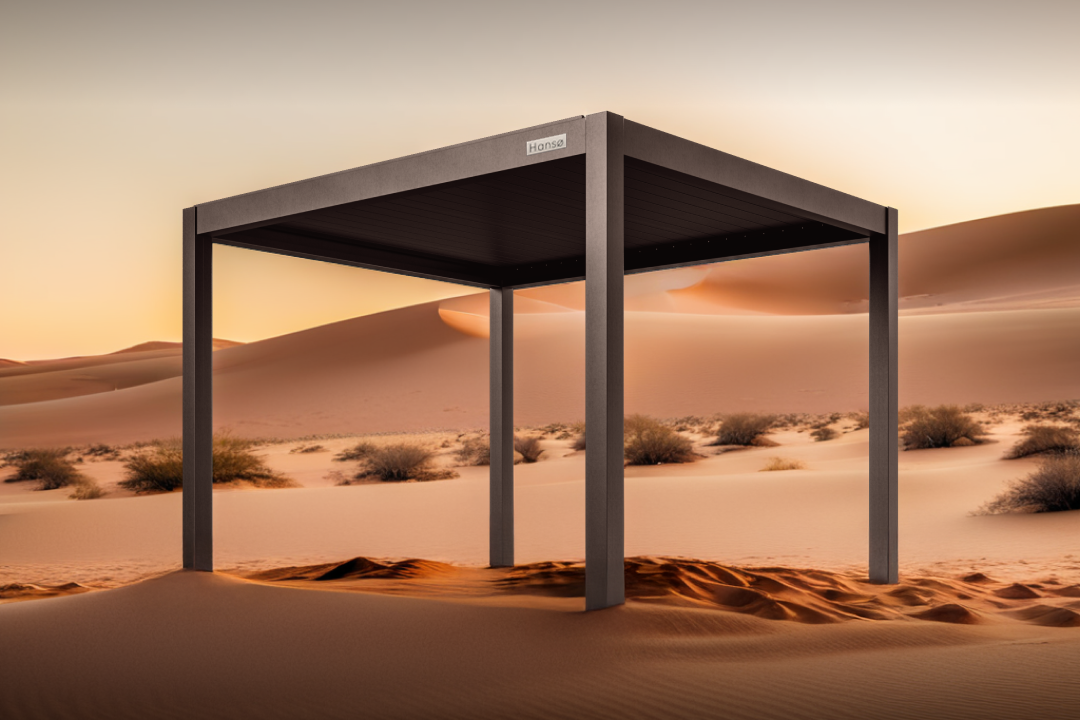
6063-T6 aluminum throughout, 165 mph Cat 5 wind rating backed by a publicly available 49-page SAP2000 / IBC 2024 structural report, AkzoNobel coating with a separate 7-year warranty, SUS304 stainless baseplates, native Alexa + Google + Apple HomeKit.
$11,950 MSRP
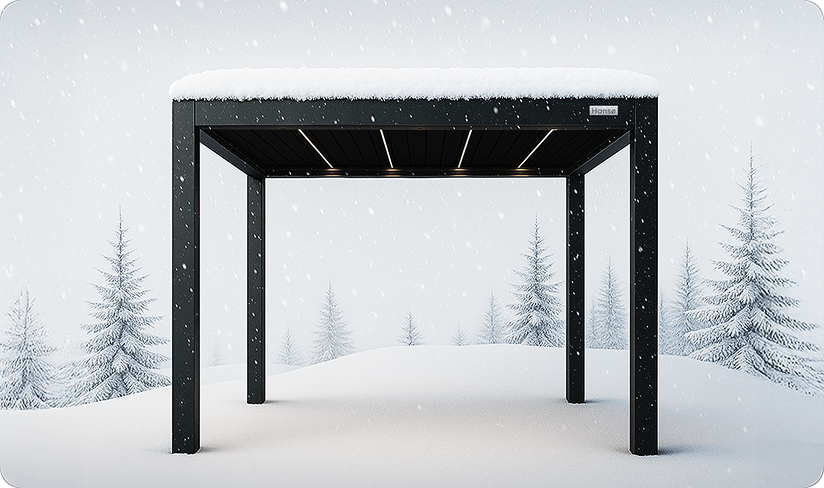
Extra-thick 6063-T6 sections, 165 mph Cat 5 wind rating, 62 PSF snow load, motorized auto-shades, the full Skyview LED system, and the same published structural report basis as the Horizon.
StruXure Pergola X
$40,000–$70,000 installed
The only ICC-certified louvered pergola on the U.S. market. Custom dimensions to the inch, every smart feature standard, lifetime structural warranty. Worth it when the budget has no ceiling and the project needs ICC certification for permitting.
Mirador 111S
$2,399 MSRP
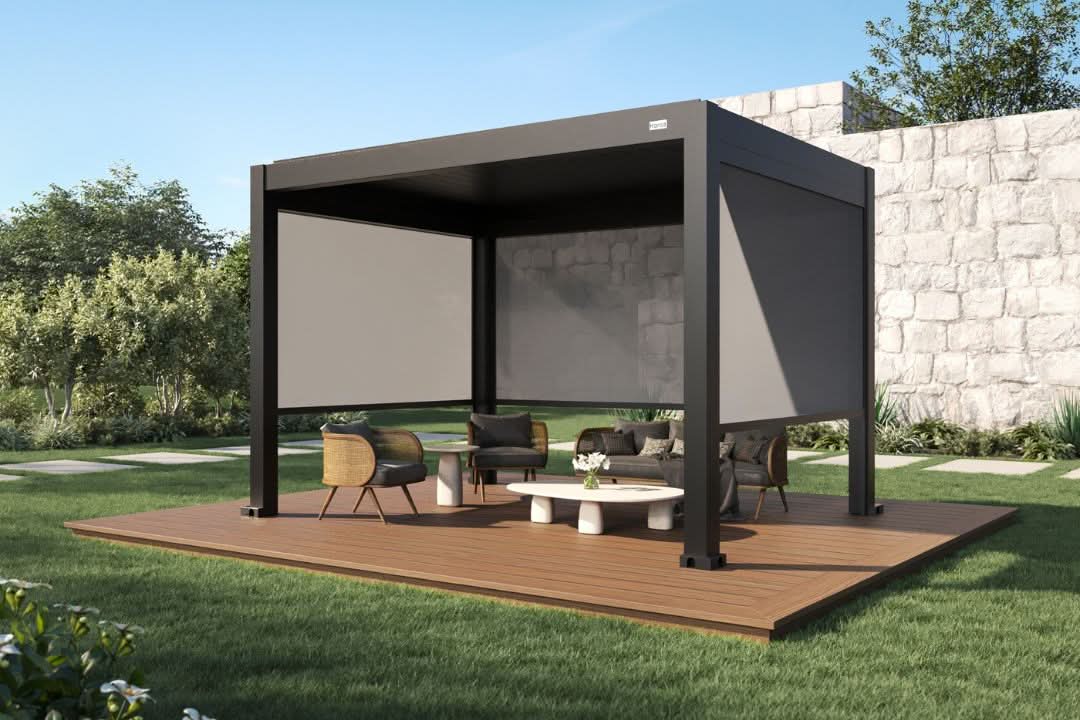
Available at Lowe's, Home Depot, and Costco. Buys an instant-availability louvered pergola with the spec trade-offs the price implies — 70 mph wind, 4-year warranty, mixed aluminum and galvanized steel.
How we evaluated each brand
Every claim in this guide is sourced to one of four document types: each brand's product page (specs, prices, warranty terms), BBB profile (corporate registration, complaint history), U.S. Customs filings (country of origin, import volume), and publicly available structural engineering reports where the brand publishes them. The evaluation criteria match what a structural engineer would actually check: aluminum temper, published structural calculations, warranty fine print, coating supplier and warranty length, baseplate alloy, smart-home integration depth, and installed cost per square foot.
Aesthetic preferences, dealer relationships, designer reputation, and color customization are real factors in a pergola purchase, but they are not what this guide is about. Pricing reflects each brand's MSRP as displayed at checkout in May 2026; brands that run permanent promotional pricing have both the MSRP and the discount pattern noted.
The U.S. louvered pergola market in 2026 has split into two tiers that look identical at a glance. One tier ships documented engineering: published structural reports, named aluminum tempers, premium coatings with separate warranties. The other tier ships the impression of engineering: headline numbers without underlying math, generic powder coats, fine print that voids the warranty if the buyer misses the 30-day registration window.
A $7,500 pergola in 2026 can mean a 49-page SAP2000 finite-element analysis validated to IBC 2024 and ASCE 7-16, or a permanent-sale-price product with no engineering document behind it at all. Same shelf, same headline numbers, different ten-year outcome.
This guide compares the eight louvered pergola brands U.S. homeowners are most likely to encounter in 2026. The criteria match what a structural engineer would actually evaluate. (Buyers still deciding whether a louvered pergola is the right structure for their backyard may want to start with why a pergola is the most useful outdoor investment or the pergola vs gazebo comparison.)
Every claim is sourced to manufacturer documentation, BBB profiles, U.S. Customs filings, or published engineering reports. Where a number is claimed but not backed by a public document, the table says so explicitly.
The eight brands worth comparing
In 2026, eight louvered aluminum pergola brands sell into the U.S. market at meaningful volume: PurpleLeaf, Mirador, BonPergola, FlexPatio, Pergolux, Hansø, The Luxury Pergola, and StruXure. They cover four price bands, from $1,999 retail kits to $70,000 dealer installations. The right brand for you depends mostly on which band you're shopping in and how much engineering you want under the marketing.
These twelve products represent eight brands and cover the louvered pergola lineup U.S. homeowners encounter at meaningful purchase volume in 2026. Smaller regional builders and discontinued lines are excluded.
Prices below are MSRP. Some brands in this category run a permanent 30 to 40 percent "sale" against an inflated reference price that has never been the actual selling price at checkout. Hansø lists MSRP as the actual transaction price.
| Rank | Brand and model | Starting price | Best for |
|---|---|---|---|
| 1 | PurpleLeaf Caesar | $1,999 | Cheapest entry point |
| 2 | Mirador 111S | $2,399 | Retail availability (Lowe's, Home Depot) |
| 3 | FlexPatio POWER+ | $4,699 | Built-in outlets |
| 4 | BonPergola Villa | $4,999 | Customer service |
| 5 | Hansø PRO+ | $6,120 | Best-selling sub-$7K |
| 6 | Pergolux Pergola 4 (Standard) | $6,490 | Manual roof, base Series 4 |
| 7 | Hansø Horizon | $7,488 | Best overall engineering value |
| 8 | Pergolux Pergola 4 Pro (Sundream) | $7,990 | Motorized, mid Series 4 |
| 9 | Pergolux Pergola 4 Pro Max (Skydance) | $11,490 | In-louver LED, top Series 4 |
| 10 | Hansø Master+ | $11,950 | Best flagship under $15K |
| 11 | The Luxury Pergola Pro | $12,209+ | U.S.-manufactured |
| 12 | StruXure Pergola X | $40K–$70K installed | ICC-certified custom |
Starting price signals the entry point, not the ten-year outcome. To predict which pergola is still standing in 2046, the analysis has to extend to the specs that brands do not always volunteer on the product page.
Six questions that actually matter
When two pergolas look comparable in the marketing photography, six questions separate the engineering from the impression of engineering. Each one maps to a section of this guide.
- What grade of aluminum is in the structure, T5 or T6? If the brand can't tell you, that is the answer.
- Is there a published engineering report, or just a wind-rating number on a product page? A number with no math behind it is a wish, not a spec.
- What does the warranty actually cover, for how long, with what exclusions? Read the warranty document, not the headline.
- What coating is protecting the metal, and is it warranted separately? The coating is what decides what your pergola looks like in year ten.
- What is holding the posts to the ground, aluminum baseplates or stainless steel? In a coastal or poolside environment, this is the failure point.
- What is the all-in cost per square foot once installation is in? Sticker price and installed price are not the same number.
Each section below walks through one question. The master comparison table at the end of the guide consolidates every brand on every criterion in a single view.
Aluminum grade: T5 vs T6 is the spec most brands won't print
Direct answer: 6063-T6 aluminum is the correct temper for a structural pergola. Per the Aluminum Design Manual 2020, T6 delivers 54% higher tensile yield strength and 89% higher compressive yield strength than 6063-T5. Hansø Horizon, Hansø Master+, and The Luxury Pergola Pro publish T6 across the structure. Most brands in the $4,000-$8,000 tier either use T5 or do not disclose the temper at all.
Aluminum temper is the single most important number on a pergola data sheet, and the one most brands omit from the product page. Almost every louvered pergola on the U.S. market is built from the 6063 aluminum alloy. The difference between a structural pergola and a glorified shade canopy is the temper, the heat-treatment process that determines how much load the metal carries before permanent deformation.
T5 is the cheaper, faster-to-extrude variant. T6 requires solution heat-treatment plus artificial aging. The strength gap is large and shows up in the three numbers that matter for a roof structure.
Material Strength · Aluminum Design Manual 2020, Table A.4.1
6063-T5 vs 6063-T6 yield and tensile strength
T6 is the temper a structural engineer specs when the part has to carry load. Most competing pergolas in the $4,000-$8,000 tier ship with T5 or do not disclose the temper.
Tensile yield strength (PSI)
Compressive yield strength (PSI)
Ultimate tensile strength (PSI)
A T6 pergola resists 54% more bending stress before yielding and 89% more compressive load through the posts. That gap is what carries the February snow load and the August gust load.
Here is how the brands compare on disclosed aluminum temper. Some entries required cross-referencing customs records and product-page footnotes because not every brand prints the temper.
T6 throughout
Hansø Horizon and Master+
$7,488 / $11,950
6063-T6 in posts, beams, and louvers. Master+ uses extra-thick T6 sections. The temper is printed in the engineering report you can download from the product page.
T6, U.S.-extruded
The Luxury Pergola Pro
From $12,209+
U.S.-extruded 6063-T6. Comes in at roughly 60 percent more than the Horizon.
Temper not disclosed
Pergolux Pergola 4 (Standard / Pro / Pro Max)
$6,490 – $11,490
The new Series 4 line raised the headline wind rating to 165 mph and the snow load to 55-75 PSF. The aluminum temper is not printed on the product pages, and on the prior S3 line the main structure was 6063-T5. No engineering report for Series 4 has been published yet.
T5 main
Hansø PRO+
$6,120
6063-T5 with selective T6 reinforcement at high-stress connections. Priced accordingly, with the same 10-year structural warranty as the rest of the lineup.
Mixed metals
Mirador 111S
From $2,399
Aluminum frame with galvanized steel louvers. Mixed-metal systems carry galvanic-corrosion and differential-expansion risk over time.
Not disclosed
PurpleLeaf, BonPergola, FlexPatio
$1,999 – $4,999
Alloy and temper are not disclosed on the product page. PurpleLeaf lists 18-gauge / 1.5mm wall thickness without naming the alloy.
If a brand's product page does not disclose the aluminum temper, ask in pre-sale chat. A salesperson who cannot answer is working from marketing material, not engineering documentation. That is a useful data point on its own.
Published engineering vs claimed wind ratings
Direct answer: Wind-rating evidence comes in three tiers. Tier 1 is an ICC Evaluation Service Report (StruXure is the only louvered pergola brand that holds one). Tier 2 is a publicly available structural calculation report from a licensed engineer (Hansø publishes a 49-page SAP2000 / IBC 2024 / ASCE 7-16 report for the Horizon and Master+). Tier 3 is a number printed on a product page with no underlying document, which is where most of the market sits.
Wind ratings come in three evidence tiers. The order matters because the tiers are not interchangeable.
ICC certification through an Evaluation Service Report. Only StruXure holds this in the louvered pergola category. ICC is the same building-code certification used for commercial structures, and in many U.S. jurisdictions it removes the need for separate PE-stamped drawings.
It is the gold standard, and it is expensive to obtain and maintain. That cost is part of why StruXure prices land at $40,000-$70,000 installed.
A publicly available structural calculation report from a licensed engineer. Hansø publishes a 49-page report for the Horizon and Master+, run through SAP2000.v25 and validated against the International Building Code (IBC) 2024 and ASCE 7-16. Every post, beam, louver, connection, and baseplate has its utilization ratio printed.
The Horizon's beam deflection comes in at 0.79" against an allowable 0.85" (L/175 per AAMA TIR-A11-2015). The baseplate anchor utilization sits at 0.858. The full calculation document is available on the product page before purchase.
A self-claimed number on a product page. Most of the louvered pergola market sits in this third tier. The number may be accurate. Without a public document, there is no way to verify.
The underlying document matters because wind-rating numbers are not measured the same way across brands. Sustained-wind speed and 3-second gust speed are different metrics. Exposure category, directionality coefficient, and gust factor all shift the result.
Two pergolas labeled "150 mph" may have been calculated against completely different assumptions. The only way to know is to read the structural report.
Here is how the brands sort, going by their own published evidence:
| Brand | Wind | Snow | Engineering evidence |
|---|---|---|---|
| Hansø Horizon | 165 mph | 60 PSF | 49-page IBC 2024 / ASCE 7-16 report, SAP2000 FEA, public |
| Hansø Master+ | 165 mph | 62 PSF | Same engineering basis, thicker sections, public |
| StruXure Pergola X | Meets IBC | Meets IBC | ICC ESR (only louvered pergola with one) |
| Luxury Pergola Pro | 130–160 mph | 60 PSF | PE stamps available for all 50 states |
| Pergolux Series 4 | 165 mph claimed | 55–75 PSF claimed | Not published |
| FlexPatio POWER+ | 120 mph | 28 PSF | Cites a "U.S. Building Products Code" that does not exist |
| BonPergola Villa | 80 mph | 10–15 PSF | Not published |
| Mirador 111S | 70 mph | Not published | Not available |
| PurpleLeaf Caesar | 40–70 mph | Lab claim only | Not available |
Wind Rating · Maximum claimed or FEA-validated
Where each brand falls on the wind-rating scale
Bars are colored by evidence tier. FEA-validated ratings are backed by a publicly available structural calculation. Claimed ratings appear on product pages with no underlying engineering document.
Maximum wind rating (mph)
StruXure Pergola X is excluded from this visualization because its ICC-certified rating is engineered per project and varies by site. *Pergolux Series 4 raised the headline rating from 150 mph (S3) to 165 mph in 2026; the supporting structural report has not been published.
About TÜV. A TÜV certificate verifies that a factory's quality-control processes meet a European standard. It is a useful credential but not equivalent to an ICC Evaluation Service Report or a publicly available U.S. structural calculation.
A TÜV stamp paired with a wind-rating claim but no underlying structural report is a factory audit plus a marketing number, not engineering documentation a U.S. building inspector can rely on.
One pattern is worth flagging in this category. When one brand publishes a 49-page structural report and competitors do not, two responses are possible. One is to publish a comparable report. The other is to raise the headline numbers on the next product generation without publishing the math behind them.
Pergolux's recent Series 4 launch raised the lineup-wide wind rating from 150 mph (S3) to 165 mph, and the snow load from "up to 50 PSF" to 55-75 PSF. Both numbers now match or exceed Hansø's published figures on paper. The Series 4 engineering report has not been published, and the aluminum temper is not disclosed on any product page.

The distinction is not small. A spec-sheet number is easy to print. The 49 pages of finite-element math behind it are not.
A buyer evaluating two pergolas that both claim 165 mph has no way to compare them without the calculation document. The Horizon's structural report is available on the product page. The Series 4 equivalent is not.
Mirador's 70 mph rating is below the Category 1 hurricane threshold. PurpleLeaf's wind rating changes depending on which page of the PurpleLeaf site is open. FlexPatio cites a U.S. building code that does not exist as a published standard.
None of this necessarily means those products will fail in service. It means the buyer has no way to verify performance before purchase. (For homeowners in hurricane or coastal zones, our guide on how to choose a wind-resistant pergola walks through what each rating tier actually means under real loads.)

Warranty fine print
Direct answer: "10-year warranty" is a marketing headline, not a coverage spec. The actual warranty depends on what is excluded (UV discoloration, transferability, electronics), the registration window, and the retail-channel penalty. The Hansø Horizon ships with a 10-year structural warranty, a separate 7-year AkzoNobel coating warranty with no UV exclusion, and 2 years on electronics, with no 30-day registration requirement.
Almost every brand in this category advertises a "10-year warranty." The covered terms are not the same across brands.
| Brand | Structural | Coating | Electronics | Notable terms |
|---|---|---|---|---|
| Hansø Horizon | 10 yr | 7 yr (AkzoNobel) | 2 yr | No UV exclusion, no registration window, coating warranted separately |
| Hansø Master+ | 10 yr | Included | 2 yr | Same as Horizon |
| Pergolux Series 4 | 10 yr | 5 yr | 2 yr | UV excluded; non-transferable; 30-day photo registration; customer pays labor |
| StruXure Pergola X | Lifetime | Included | 5 yr | Tied to original install |
| Luxury Pergola Pro | Lifetime, transferable | Included | N/A | Customer pays transport and labor |
| BonPergola Villa | 10 yr | Included | 2 yr | Halved to 5 yr if bought via Amazon or Wayfair |
| FlexPatio POWER+ | 10 yr frame | 3 yr LEDs | 1 yr motor | Cites a non-existent certification code |
| Mirador 111S | 4 yr total | Included | Included | Shortest in this guide |
| PurpleLeaf Caesar | 1 yr | Included | Included | Support via Gmail address |
A 10-year warranty that excludes UV discoloration on a structure that lives in the sun is doing something specific with the word warranty. A 10-year warranty requiring photo-documented registration within 30 days of delivery is structured to be voided by paperwork failure. A 10-year warranty cut in half by purchasing through Amazon is a retail-channel penalty, not a coverage promise.
None of those exclusions make a product bad in service. They do define what to expect when something fails.
A note on the Hansø Horizon, since some older comparison pieces still describe it as a 10/5/1 layered warranty. That figure is out of date. The current Gen 5 spec is 10 years structural, 7 years on the AkzoNobel coating (separate document), and 2 years on electronics, with no UV exclusion and no 30-day registration window.
The coating warranty is published as its own document on the Horizon product page. (Full structural, coating, and electronics terms live on the Hansø warranty page.) Coating is the failure mode most brands quietly leave out of the headline warranty number.
The warranty is whatever the fine print says. Not the headline.
Coating: AkzoNobel vs generic powder
Direct answer: Powder coat quality determines how a pergola looks in year 10. AkzoNobel is the premium architectural coating supplier used by Aston Martin, Rolls-Royce, NASA, and luxury yacht builders. Hansø specifies AkzoNobel across every model and backs the Horizon with a dedicated 7-year coating warranty with no UV exclusion.
Coating is the spec almost no buyer asks about, and the one that decides what a pergola looks like in 2036. Powder coating is not a commodity category. The performance gap between a budget powder coat and a premium architectural coating shows up in the 7-to-10-year range, when budget coatings start to chalk and fade.
Hansø specifies AkzoNobel premium powder coat across the PRO+, Horizon, and Master+. The Horizon is backed by a dedicated 7-year coating warranty published separately from the 10-year structural warranty.
Pergolux also references AkzoNobel in some materials with a 5-year coating warranty. The Pergolux warranty terms explicitly exclude "slight discoloration in paint due to UV radiation," which is the failure mode the coating warranty is supposed to cover on an outdoor structure.
StruXure uses an industrial powder coat with custom color matching, priced into the premium package. Mirador, BonPergola, FlexPatio, and PurpleLeaf use unspecified powder coats and typically bundle the coating into an undifferentiated structural warranty.
A brand that cannot name the supplier of the coating protecting its aluminum has already answered the question.

Baseplates and hardware
Direct answer: Baseplates are the corrosion failure point in coastal, poolside, and de-icing-salt environments. The Hansø Horizon specifies SUS304 stainless steel baseplates as standard with M10x100 SUS304 expansion bolts rated at 12 kN (2,698 lbs) tension capacity per anchor. Almost no competitor in the sub-$10,000 tier specifies stainless steel baseplates as standard.
Baseplates are where the pergola meets the slab, the deck, or the footing. They are the failure point in coastal, poolside, and de-icing-salt environments. They are also the cheapest place to save money at the factory.
Most brands at every price tier use aluminum baseplates. Aluminum baseplates perform fine in inland, sheltered installations. In salt air, on a chlorinated pool deck, or on a salt-treated wood substructure, aluminum baseplates corrode faster than the structure above them.
The Hansø Horizon ships with SUS304 stainless steel baseplates as standard, the same marine-grade alloy used in yacht hardware. The structural report documents the baseplate connection at 0.858 utilization under maximum design load. The stainless upgrade adds roughly $200 to $400 at the factory.
Almost no competitor in the sub-$10,000 tier specifies stainless baseplates as standard. The spec is one of the easiest indicators of whether a brand engineered for 10 years of service or 10 months of product photography.

Smart home integration
Direct answer: The Hansø Horizon is the only louvered pergola under $10,000 that natively supports Alexa, Google Home, and Apple HomeKit simultaneously. Pergolux Series 4 supports the Matter protocol (Alexa, Google) but not HomeKit. StruXure includes smart features standard in the dealer-configured package.
Smart home support has become table stakes in the mid-range pergola market. The depth of integration is not uniform across brands.
The Hansø Horizon natively supports Alexa, Google Home, and Apple HomeKit on a single integration. The Hansø Master+ adds motorized auto-shades and the full Skyview LED system on top of the same smart-home stack.
The Pergolux Pergola 4 Pro and Pergola 4 Pro Max support the Matter protocol, which works with Alexa and Google Home. The current Pergolux implementation does not extend to Apple HomeKit.
StruXure ships every Pergola X with smart features standard, configured by the dealer. Mirador 111S E-MOTION offers remote and app control without HomeKit. FlexPatio POWER+ uses app control and adds the unusual feature of built-in electrical outlets.

BonPergola uses app control. PurpleLeaf, base Mirador, and Luxury Pergola ship without smart-home integration on standard configurations.
For a household running Apple HomeKit, the Hansø Horizon is the only sub-$10,000 product that plugs in without a third-party bridge. That feature is decisive for some buyers and one signal among several for most.

Where it's built and what that does to price
Direct answer: The louvered pergola industry runs on three business models with three different installed-cost profiles. Dealer-installed (StruXure): $220-$310 per sq ft. U.S.-manufactured boutique (The Luxury Pergola): roughly $65-$100 per sq ft. Direct-to-consumer (Hansø, Pergolux, BonPergola, FlexPatio, PurpleLeaf, Mirador): $35-$70 per sq ft.
Three business models dominate the louvered pergola category. Each produces a different installed-cost profile and different lead times.
The dealer model. Manufacturer → distributor → dealer → certified installer → homeowner. Each layer adds 30 to 60 percent margin. StruXure is the clearest example, priced at $40,000 to $70,000 installed for a 12x16 (roughly $220 to $310 per square foot).

The U.S.-manufactured boutique model. A small team builds each unit in the Midwest, with lifetime warranties and longer lead times. The Luxury Pergola runs this model with a six-employee team in Indiana and a typical range of $12,209 to $18,583. The price reflects U.S. labor and small-shop overhead.

The direct-to-consumer model. Factory builds the unit, freight delivers it to the homeowner's door, the buyer installs it directly or hires a local installer for $1,000 to $1,500. Hansø, Pergolux, BonPergola, FlexPatio, PurpleLeaf, and Mirador all operate variations of this model. (More on the economics of buying direct vs. dealer-installed for buyers comparing the two paths.)
The cost per square foot installed lands in a much narrower band than the headline price suggests. (For a full breakdown by configuration and tier, see our guide on how much a louvered pergola actually costs.)
| Brand | Cost per sq ft installed (12x16) |
|---|---|
| Hansø Horizon | ~$45–50 |
| Mirador 111S E-MOTION | ~$35–55 |
| Pergolux Pergola 4 Pro Max | ~$65–70 |
| Hansø Master+ | ~$70 |
| StruXure Pergola X | ~$220–310 |
The trade-off in the direct-to-consumer model lives in lead time. Hansø ships factory-direct: 10 to 14 weeks for all made-to-order products. Pergolux ships from U.S. warehouses with a stated 5 to 15 business days for limited in-stock models, while most of the lineup ships in 55 to 63 business days (11 to 13 weeks).
The longer Hansø lead time is the reason the Horizon includes 6063-T6 aluminum, AkzoNobel coating, and SUS304 stainless baseplates at a $7,488 MSRP. There is no U.S. warehousing overhead, no distributor margin, no last-mile freight markup. The savings show up on the spec sheet rather than the corporate footprint.
For an install date 10 to 14 weeks out, the math favors factory-direct. For an install needed within four weeks, retail brands at Lowe's or on Amazon will ship faster, and the spec sheets reflect why.

The master comparison
The category splits naturally into two tiers. The first tier publishes structural engineering and discloses materials. The second tier competes on retail availability and price.
Engineered tier · brands with published documentation
| Spec | Hansø Horizon | Hansø Master+ | Pergolux Pro Max | StruXure X | Luxury Pergola |
|---|---|---|---|---|---|
| Price (MSRP) | $7,488 | $11,950 | $11,490 | $40K–$70K inst. | $12,209+ |
| Aluminum | 6063-T6 | 6063-T6 thick | Not disclosed | 6063 (N/A) | 6063-T6 |
| Wind rating | 165 mph FEA | 165 mph FEA | 165 mph claimed | Meets IBC | 130–160 mph |
| Snow load | 60 PSF FEA | 62 PSF FEA | 75 PSF claimed | Meets IBC | 60 PSF |
| Engineering report | 49-page, public | Same, public | Not published | ICC ESR | 50-state PE |
| Coating | AkzoNobel + 7 yr | AkzoNobel | AkzoNobel, UV excl. | Industrial | U.S. powder |
| Baseplates | SUS304 stainless | Reinforced steel | Aluminum | Standard | Standard |
| Smart home | Alexa + Google + HomeKit | Full + auto shades | Matter only | Standard | None |
| Warranty (str / coat / elec) | 10 / 7 / 2 yr | 10 / incl. / 2 yr | 10 / 5 / 2 yr* | Lifetime / incl. / 5 yr | Lifetime / incl. / N/A |
Within the engineered tier, two products claim a 165 mph wind rating and a snow load above 60 PSF. One backs those numbers with a publicly available 49-page structural calculation. The other does not.
Value tier · brands under $5,000
| Spec | BonPergola Villa | FlexPatio POWER+ | Mirador 111S | PurpleLeaf Caesar |
|---|---|---|---|---|
| Price (MSRP) | $4,999 | $4,699 | $2,399 | $1,999 |
| Aluminum | Not disclosed | Not disclosed | Mixed metals | 18 ga / 1.5 mm |
| Wind rating | 80 mph | 120 mph | 70 mph | 40–70 mph |
| Snow load | 10–15 PSF | 28 PSF | Not published | Lab claim only |
| Engineering report | Not published | Not available | Not available | Not available |
| Coating | Standard | Standard | Standard | Standard |
| Smart home | App | App + outlets | E-MOTION only | Remote |
| Warranty | 10 yr (halved on Amazon) | 10 yr frame / 1 yr motor | 4 yr total | 1 yr |
At this tier, no brand publishes a structural engineering report and no brand discloses the aluminum temper. The differences are in retail availability, smart-home features, and which warranty terms void first.

*Pergolux Pergola 4 Pro Max warranty terms exclude UV discoloration, are non-transferable, and require photo-documented registration within 30 days of delivery. Customer pays labor on all claims.
Final picks by category
The bottom-of-article verdict, drawn from the spec analysis above. Each brand wins the category where its design choices and price point produce the strongest fit.
| Category | Best pick | Why it wins |
|---|---|---|
| Best Overall | Hansø Horizon | Strongest engineering-per-dollar in the category. 6063-T6 aluminum throughout, 165 mph Cat 5 wind rating backed by a publicly available 49-page SAP2000 / IBC 2024 structural report, AkzoNobel coating with a separate 7-year warranty, SUS304 stainless baseplates, native Alexa + Google + Apple HomeKit. $7,488 MSRP. |
| Best Premium Engineering | Hansø Master+ | Flagship Cat 5 wind rating with extra-thick T6 sections, 62 PSF snow load, motorized auto-shades, full Skyview LED, and the same published structural calculation basis as the Horizon. The strongest documented engineering under $15,000. $11,950 MSRP. |
| Best Custom & ICC-Certified | StruXure Pergola X | The only ICC-certified louvered pergola on the U.S. market. Custom dimensions to the inch, every smart feature standard, lifetime structural warranty. The right choice when budget is open and the project needs ICC certification for permitting. |
| Best U.S.-Made | Luxury Pergola Pro | U.S.-extruded 6063-T6 aluminum, built in Indiana by a small team. PE-stamped engineering available for all 50 states. Lifetime transferable warranty. The right choice when domestic manufacturing is a non-negotiable. |
| Best LED System | Pergolux Pro Max | In-louver LED lighting integrated directly into the 9.6" dual-wall louver blades. A visually distinctive feature unique to Pergolux in the direct-to-consumer market. |
| Best Customer Service | BonPergola Villa | NAHB and ProBuilder award-winning support team with documented responsiveness. The right choice when ongoing service matters more than peak structural performance, in a mild climate. |
| Best Built-In Outlets | FlexPatio POWER+ | Integrated electrical outlets built into the structure itself. The only louvered pergola in the category that solves the extension-cord problem for outdoor kitchens and entertainment areas. |
| Best Budget Retail | Mirador 111S | Available immediately at Lowe's, Home Depot, and Costco. Red Dot–winning design, decent assembly experience, 4-year warranty. The most accessible louvered pergola on the U.S. market. |
| Cheapest Entry | PurpleLeaf Caesar | Lowest absolute price point in the category at $1,999. Functions as a 3-to-5-year shade solution rather than a permanent structural investment. |

Frequently asked questions
What is the strongest pergola you can buy in 2026?
By engineering spec backed by a published structural report, the strongest residential louvered pergolas on the U.S. market are the StruXure Pergola X (ICC-certified, custom-engineered per project, $40,000 to $70,000 installed) and the Hansø Master+ ($11,950, 165 mph Category 5 wind rating, 62 PSF snow load, extra-thick 6063-T6 aluminum, full SAP2000 finite-element report). The Hansø Horizon ($7,488) delivers comparable structural performance to the Master+ at a meaningfully lower price.
Is 6063-T6 aluminum actually stronger than 6063-T5?
Yes, and the gap matters. Per the Aluminum Design Manual 2020, T6 has 54% higher tensile yield strength and 89% higher compressive yield strength than T5. For a structural pergola that has to carry snow and wind loads year-round, T6 is the correct temper. Most competing brands in the $4,000 to $8,000 tier either use T5 or do not disclose the temper at all.
Is TÜV certification the same as ICC certification or a structural engineering report?
No. TÜV is a German factory-quality certification. It verifies that a factory's quality-control processes meet a European standard. It is not a U.S. building-code certification, and it does not substitute for an ICC Evaluation Service Report (which StruXure holds) or for a publicly available structural calculation report compliant with the current IBC and ASCE 7 standards (which Hansø publishes for the Horizon and Master+). When you are evaluating a pergola for U.S. permitting, ask for the engineering report, not the factory certificate.
What is the best pergola brand for hurricane and coastal zones?
For published Category 5 wind ratings, the Hansø Horizon (165 mph, FEA-validated to ASCE 7-16) and the Hansø Master+ (165 mph, thicker T6 sections) are the strongest direct-to-consumer options. StruXure meets equivalent or better ratings via ICC certification, but at five to ten times the installed price. For coastal salt-air environments specifically, the SUS304 stainless steel baseplates on the Hansø Horizon are the spec to look for.
How much should you actually expect to pay for a quality louvered pergola?
Roughly four price bands. $2,000 to $3,500 for entry-level retail (PurpleLeaf, Mirador). $4,500 to $7,500 for the mid-range value tier (Hansø PRO+ at $6,120, Hansø Horizon at $7,488, BonPergola, FlexPatio). $8,000 to $12,000 for premium direct-to-consumer (Hansø Master+ at $11,950, Pergolux Pergola 4 Pro Max at $11,490). $40,000 and up for custom dealer-installed (StruXure). The best engineering-per-dollar lives in the mid-range value tier, specifically in the products that publish their structural reports.
Why is a 10-year warranty not always a 10-year warranty?
Because the warranty is whatever the fine print says. Some 10-year warranties exclude UV discoloration on a structure that lives in the sun. Some require photo-documented registration within 30 days of delivery. Some are non-transferable when you sell the house. Some are halved if you bought through Amazon or Wayfair. The Hansø Horizon ships with a 10-year structural warranty, a separate 7-year AkzoNobel coating warranty with no UV exclusion, and 2 years on electronics, all without a 30-day registration window. Before you sign anything from any brand, pull up the actual warranty document.
Should you worry about pergolas made overseas?
Country of manufacture matters less than the documentation and the warranty infrastructure behind it. Almost all aluminum extrusion for the U.S. residential pergola market comes from Asia regardless of which brand name is on the box, including many brands that present themselves as European or American. The questions that matter are whether the brand publishes the structural report, whether the warranty covers the failure modes you actually care about, and whether the company is structured to honor that warranty in year 8 or year 10. A 49-page engineering report and a publicly documented coating warranty travel across borders better than a corporate mailing address does.
Is Hansø Home a real company with U.S. operations?
Yes. Hansø ships into the U.S. market at meaningful volume, runs U.S. customer support and consultation lines, partners with a Hansø-certified installer network for buyers who want professional install, and publishes the structural engineering report for every flagship model on the public product page. The 10-year structural warranty, the 7-year AkzoNobel coating warranty, and the 2-year electronics warranty are all written documents you can read before you order. If a brand is going to last long enough to honor a 10-year warranty, the things to look at are documentation, customs trail, and engineering transparency, not the city on the corporate footer.
The bottom line
For the louvered pergola category in 2026, three signals separate engineering from marketing: a publicly available structural calculation report, a disclosed aluminum temper, and a coating warranty written as its own document. The brands that meet all three publish at MSRP without permanent-discount math, and they win the value-per-dollar question at every price tier above entry-level retail. The full evidence is in the tables above; the broader purchase-decision framework lives in our pergola buying guide.
Glossary: the terms used in this guide
- 6063-T5 aluminum
- The lower-strength temper of 6063 aluminum alloy. Tensile yield strength of 15,950 PSI per the Aluminum Design Manual 2020. Common in budget louvered pergolas because it is cheaper and faster to extrude than T6.
- 6063-T6 aluminum
- The structural temper of 6063 aluminum alloy. Tensile yield strength of 24,650 PSI — 54% stronger than T5 in tension and 89% stronger in compression. The correct temper for a permanent outdoor structure that has to carry wind and snow loads.
- AAMA TIR-A11-2015
- The American Architectural Manufacturers Association technical guideline that defines deflection standards for aluminum framing members (the standard is now maintained by the Fenestration and Glazing Industry Alliance). Hansø specs the Horizon's beams to L/175 per this standard.
- AkzoNobel
- The premium architectural powder-coat supplier used in aerospace, luxury automotive (Aston Martin, Rolls-Royce), and marine applications. A coating supplier choice that matters more than the powder-coat headline implies, because cheap coatings fail in the 7-to-10-year UV-exposure window.
- ASCE 7-16
- The American Society of Civil Engineers standard for "Minimum Design Loads for Buildings and Other Structures." Defines how wind and snow loads are calculated for structural engineering purposes. A wind-rating claim that does not reference ASCE 7 is not directly comparable to one that does.
- Cat 5 (Category 5) wind rating
- The highest category on the Saffir-Simpson hurricane wind scale, defined as sustained winds of 157 mph and above. A 165 mph rating falls in the Category 5


